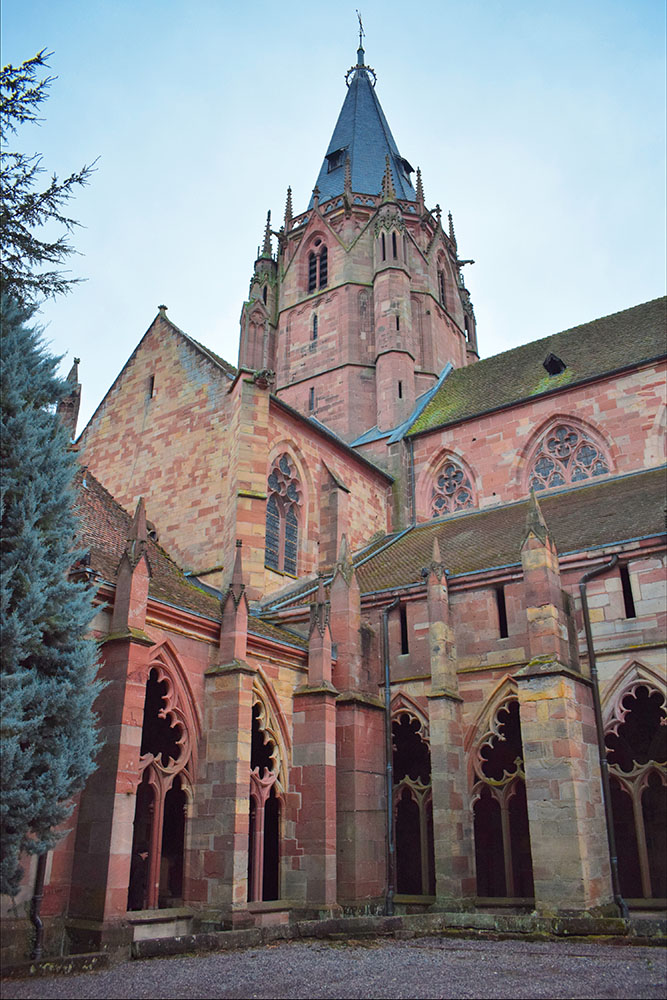

Alsace Churches have a way of surprising you when you least expect it.
Everyone knows Strasbourg Cathedral, and rightly so. It is one of the great masterpieces of Gothic Europe, the kind of monument that leaves first-time visitors speechless and seasoned travellers reaching for their cameras all over again.
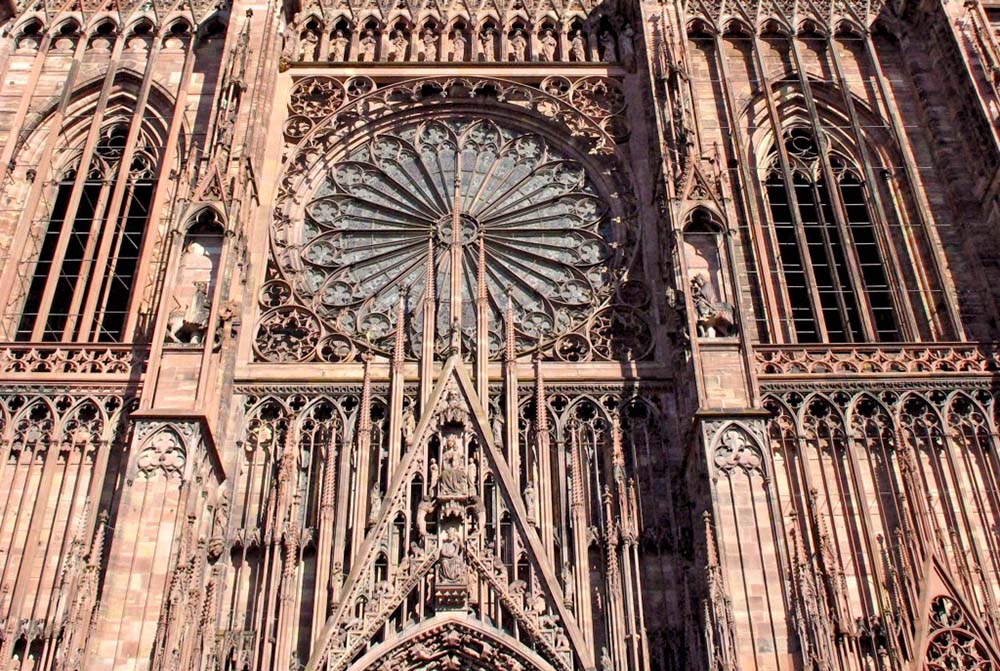
Its soaring façade, its rose window, its pink sandstone glow — all of it deserves the admiration it receives.
And yet, over the years, I have found myself just as moved, and sometimes even more deeply charmed, by other churches across Alsace.
Some stand in small towns you might otherwise pass through too quickly. Others rise unexpectedly over vineyards, market squares, or sleepy streets of half-timbered houses.
A few are grand and theatrical. Others feel more intimate, more rooted in everyday life. But all of them stayed with me.
What I love about Alsace Churches is that they reveal the region in layers.
They tell stories of free imperial cities, abbeys, pilgrimage routes, the Rhine world, the Counter-Reformation, and the quiet pride of local communities.
They also show just how varied church architecture in Alsace can be: Gothic elegance, Romanesque strength, Baroque exuberance, Neo-Gothic ambition, and even a striking Protestant landmark in the heart of Mulhouse.
So yes, Strasbourg Cathedral is magnificent. But these ten churches, scattered across Alsace, are the ones that truly stole my heart.
Alsace Churches Beyond Strasbourg Cathedral: 10 That Deserve Your Time

Strasbourg Cathedral still stands above the conversation for many travellers, and that makes perfect sense.
It is a colossal Gothic achievement and one of the most famous monuments in France.
But once you start exploring further across the region, you realise that the story of Alsace Churches does not begin and end in Strasbourg.
Some of the churches on this list impressed me with their scale. Others won me over through atmosphere, unusual interiors, remarkable stained glass, or the way they dominate a townscape.
Together, they form a different portrait of Alsace — one made not just of one world-famous cathedral, but of a whole constellation of sacred places with distinct identities.
Alsace Churches I Love #1: Saint-Martin Collegiate, Colmar

If one church outside Strasbourg comes closest to feeling cathedral-like, it is surely Saint-Martin in Colmar.
Built between 1235 and 1365, Saint-Martin Collegiate is one of the major Gothic buildings in Alsace, and its massive presence anchors Colmar’s old town with extraordinary confidence.
After a fire in 1572, the roofline was rebuilt with the distinctive lantern dome that gives the church much of its current silhouette.
I chose it for this list because it feels like the perfect counterpoint to Strasbourg Cathedral. It has grandeur, but not the same overwhelming fame.
In Colmar, it rises naturally out of the fabric of the town, surrounded by narrow streets, market life, and old façades.
I love that moment when you turn a corner and suddenly see its huge pink-and-golden mass filling the sky. It feels both monumental and deeply woven into everyday Alsatian life.
Alsace Churches I Love #2: Saint-Thiébaut Collegiate, Thann

Saint-Thiébaut in Thann is one of those churches that makes you stop almost involuntarily.
Its construction stretched from the late 13th century into the 15th century, and it is widely praised as one of the finest Gothic churches in Alsace.
Tourism sources highlight its exceptional portal and note that the building brings together the main phases of the Gothic style.
Why did I include it? Because it feels unexpectedly sophisticated for a small town at the foot of the Vosges.
The west façade is wonderfully rich, almost lace-like in places, and the sculpted portal has the kind of detail that rewards a slow visit.
There is something deeply satisfying about finding a church of this calibre in Thann, away from the region’s most obvious visitor trail.
It reminds you that Alsace keeps some of its finest treasures where you are least prepared for them.
Alsace Churches I Love #3: Saint-Georges, Sélestat
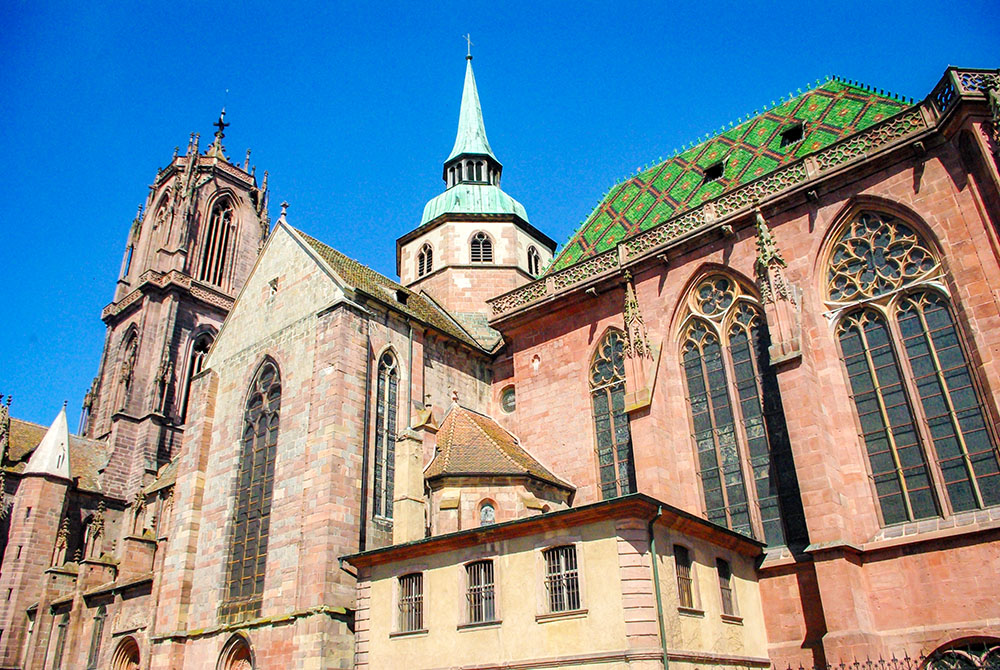
Saint-Georges in Sélestat is one of those churches that quietly asserts itself.
Construction began in the 1220s and continued until shortly before 1500. The church’s Gothic tower reaches around 60 metres and is one of the defining landmarks of Sélestat.
I included it because it captures something I love about Sélestat itself: seriousness without showiness.
It is a large and noble church, but not one that usually dominates tourist wish lists.
And yet, once inside, you feel its dignity immediately. There is a calmness to Saint-Georges that I find very appealing.
It does not need spectacle. It has proportion, age, and presence — and that is more than enough.
Alsace Churches I Love #4: Saints-Pierre-et-Paul Abbey Church, Wissembourg
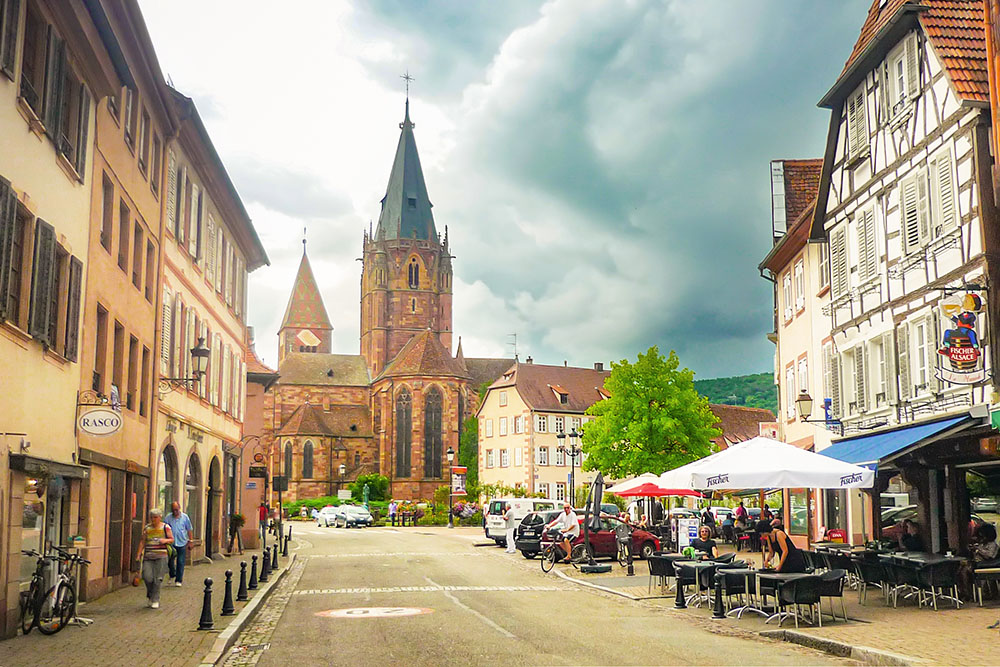
Wissembourg’s abbey church feels like the northern Alsatian answer to the region’s better-known Gothic giants.
The former abbey church of Saints Peter and Paul preserves a Romanesque bell tower from the 11th century, while much of the visible church dates from the late 13th century onward.
It is one of the most important ecclesiastical buildings in northern Alsace and is also famous for its enormous painted Saint Christopher and its large baroque organ case.
I had to include it because it combines scale and strangeness in the best possible way. Wissembourg already has such a distinctive atmosphere, close to the German border and full of quiet historical depth, and this church reinforces all of that.
It feels like a place shaped by centuries of prayer, power, scholarship, and survival.
There is something slightly austere about it at first glance, but the longer you stay, the richer it becomes.
Alsace Churches I Love #5: Notre-Dame de l’Assomption, Rouffach
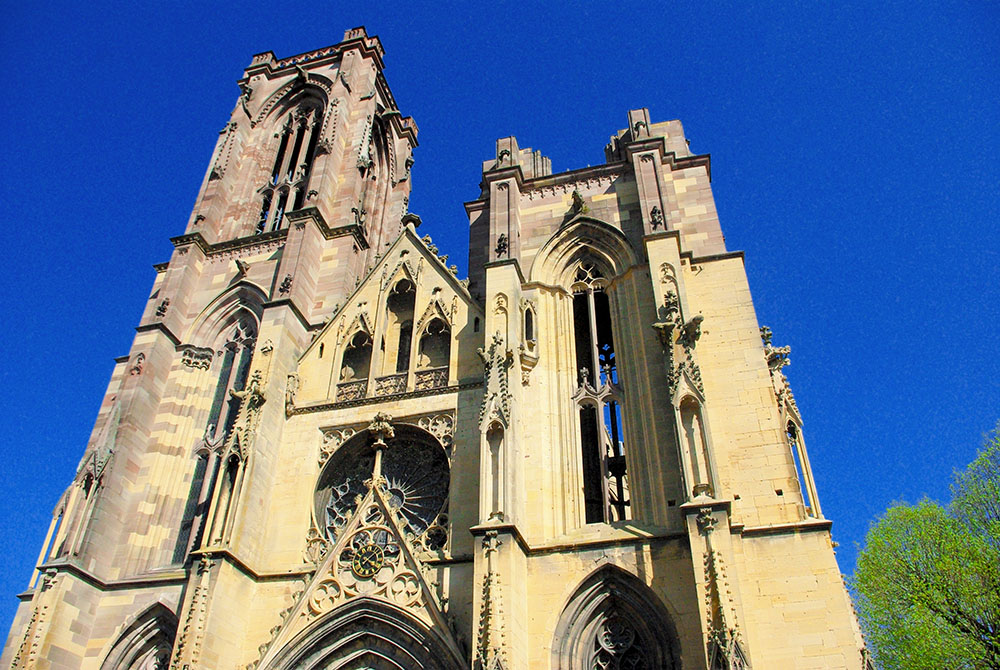
Rouffach’s church has one of my favourite silhouettes in Alsace.
Official tourism descriptions present it as a Romanesque-ogival church showing the evolution of religious architecture from the 11th to the 19th centuries.
It is also notable for its unfinished-looking western front, which only adds to its character.
I chose it because it is so visually distinctive. Not every beautiful church needs perfect symmetry or a polished façade.
Rouffach’s church feels more intriguing than that. It has the kind of irregular, time-shaped beauty that makes you look twice.
It tells a long architectural story in stone, and I find that far more moving than buildings that seem too neat, too complete, too certain of themselves.
Alsace Churches I Love #6: Jesuit Church, Molsheim
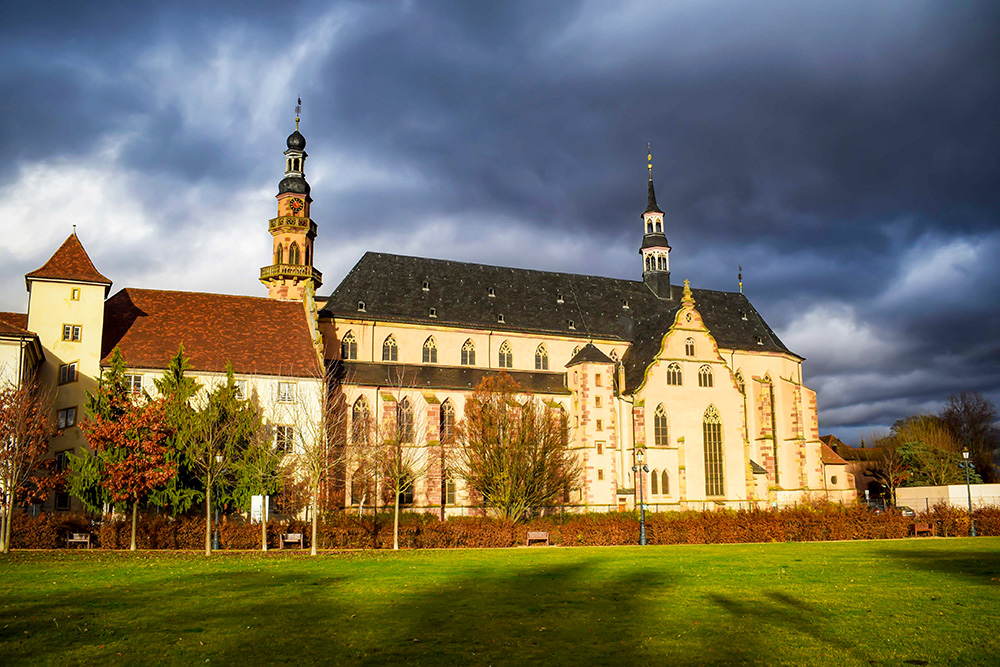
The Jesuit Church in Molsheim brings a very different chapter of Alsatian history into focus.
Its construction was authorised in 1614, and the church was built in the years that followed as part of the Jesuit presence in Molsheim, a key Catholic centre during the Counter-Reformation.
It is regarded as one of the principal 17th-century church buildings in the Rhine Valley.
I included it because this is not just a beautiful church — it is a church with historical force.
When you stand before it, you feel the confidence of an era that wanted architecture to persuade, to impress, and to proclaim.
Molsheim is not always the first place people think of when planning an Alsace itinerary, but this church alone gives the town real depth. It adds a more political and religious dimension to any journey through the region.
Alsace Churches I Love #7: Saint-Pierre-et-Saint-Paul, Obernai

Obernai is already one of the most attractive towns in Alsace, and its main church plays a major part in that.
The present Saints-Pierre-et-Paul church opened in 1872 and replaced an earlier Gothic church.
Inside, it preserves notable Neo-Gothic décor and a symphonic organ by Joseph Merklin dating from 1882.
I chose it because it shows that not all memorable Alsace Churches have to be medieval.
Sometimes 19th-century ambition can be just as compelling. Obernai’s church has height, elegance, and a striking interior atmosphere, and it suits the town beautifully.
It feels less like a relic and more like a living centrepiece, which is one reason I find it so appealing.
Alsace Churches I Love #8: Saint-Pierre-le-Jeune, Strasbourg
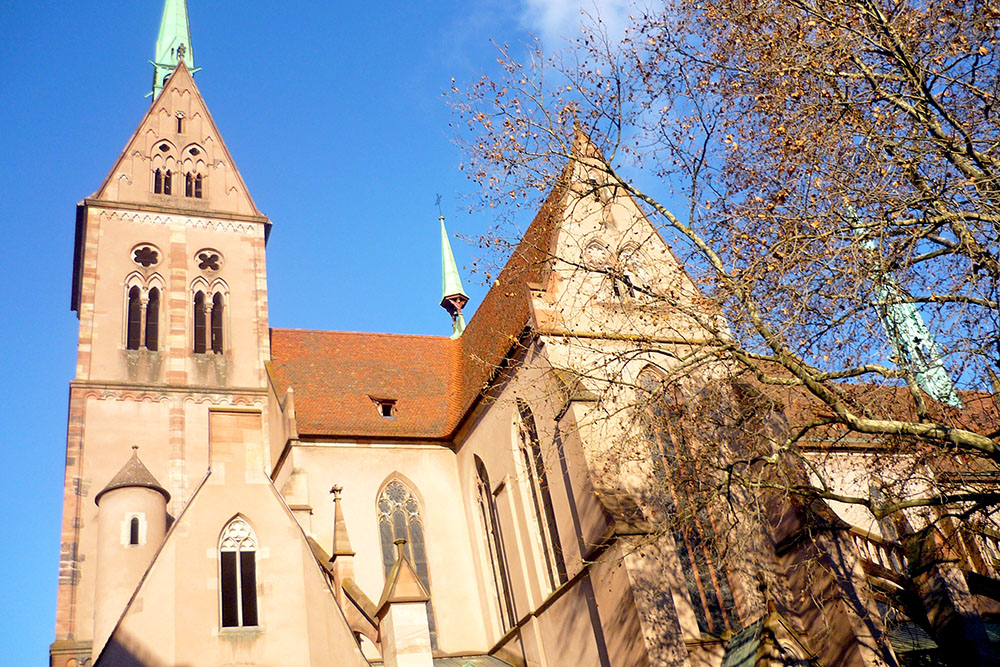
Yes, this list begins by stepping away from Strasbourg Cathedral — but I could not resist including another Strasbourg church.
Here I mean the Protestant Saint-Pierre-le-Jeune, one of the city’s most remarkable and characterful sacred buildings.
Built from 1031 onward on the site of an earlier chapel, it preserves Romanesque and Gothic elements and remains one of Strasbourg’s most atmospheric churches.
Why is it here? Because it feels intimate in a way Strasbourg Cathedral never can.
The cloister, the painted interior, the sense of age layered upon age — all of it creates a mood that is completely different from the cathedral’s theatrical splendour.
If the cathedral inspires awe, Saint-Pierre-le-Jeune invites affection. And sometimes affection lasts longer.
Alsace Churches I Love #9: Temple Saint-Étienne, Mulhouse
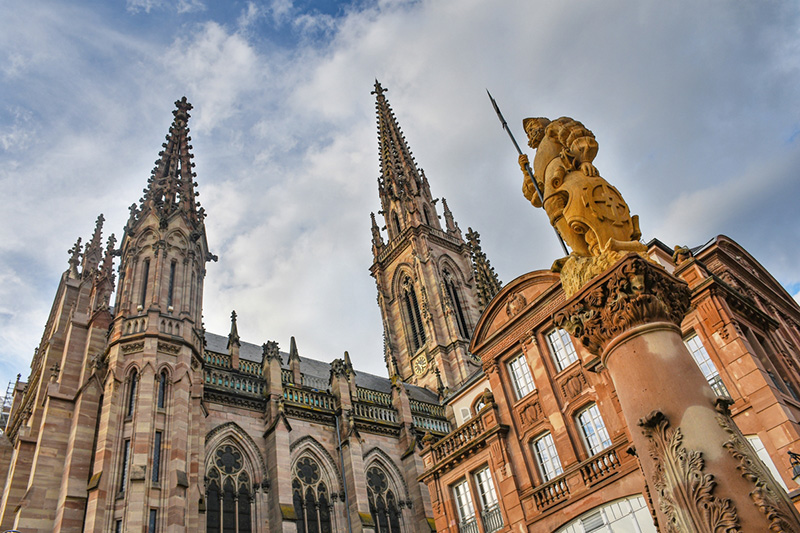
Mulhouse brings something entirely different to the list.
Temple Saint-Étienne, on Place de la Réunion, was built between 1858 and 1868 on the site of an earlier church and was designed in Neo-Gothic style by Jean-Baptiste Schacre.
It is described as the highest Protestant building in France, and it preserves magnificent stained-glass windows from the 14th century inherited from the earlier church.
I included it because it breaks the pattern in the best way. When people imagine Alsace Churches, they often think first of Catholic Gothic or Baroque buildings in wine villages and historic towns.
Mulhouse’s great Protestant temple complicates that picture. It is bold, urban, and self-assured. It belongs to a different Alsace — industrial, reformist, and open to a different architectural language.
That contrast is exactly why it deserves its place here.
Alsace Churches I Love #10: Saint-Maurice Abbey Church, Ebersmunster
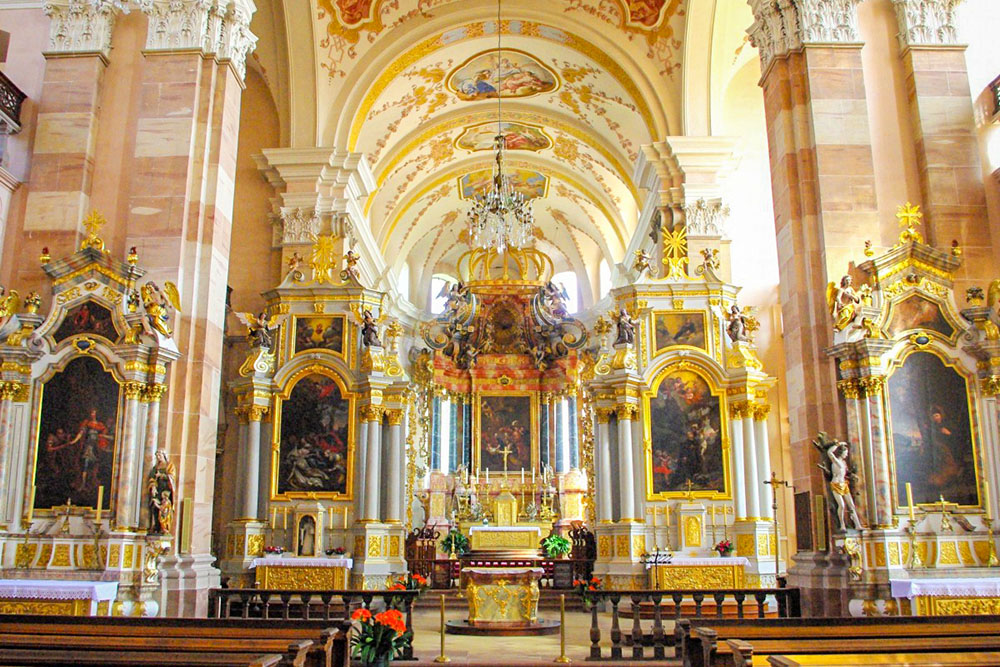
If I had to choose the most unexpectedly breathtaking interior on this list, Ebersmunster would be a very strong contender.
Official tourism descriptions call the abbey church of Saint-Maurice one of the most beautiful churches in eastern France and note its distinctive Austrian-style Baroque character.
The present church dates mainly from the early 18th century and is celebrated for its luminous painted décor and high altar.
I included it because entering this church feels like crossing a threshold into another world. From the outside, the village is quiet and unassuming. Inside, everything opens into movement, colour, theatricality, and light.
It is exuberant without being heavy, ornate without being oppressive. In a region where Gothic often dominates the conversation, Ebersmunster is a glorious reminder that Alsace Churches can dazzle in very different ways.
Conclusion: Why These Alsace Churches Stayed With Me
Strasbourg Cathedral will always deserve its reputation. But one of the joys of travelling through this region is discovering that the story of Alsace Churches is so much wider, richer, and more varied than one monument alone.
From Gothic masterpieces in Colmar and Thann to the Baroque brilliance of Ebersmunster and the Protestant confidence of Mulhouse, each of these churches reveals a different face of Alsace.
That is why I wanted to write this piece. Not to diminish Strasbourg Cathedral, but to widen the frame.
These churches stole my heart because each of them offered something memorable: a silhouette, an atmosphere, a historical echo, a feeling of place.
And in the end, that is often what stays with us most when we travel — not just the famous landmark everyone expected us to admire, but the quieter places that surprised us into loving them.