
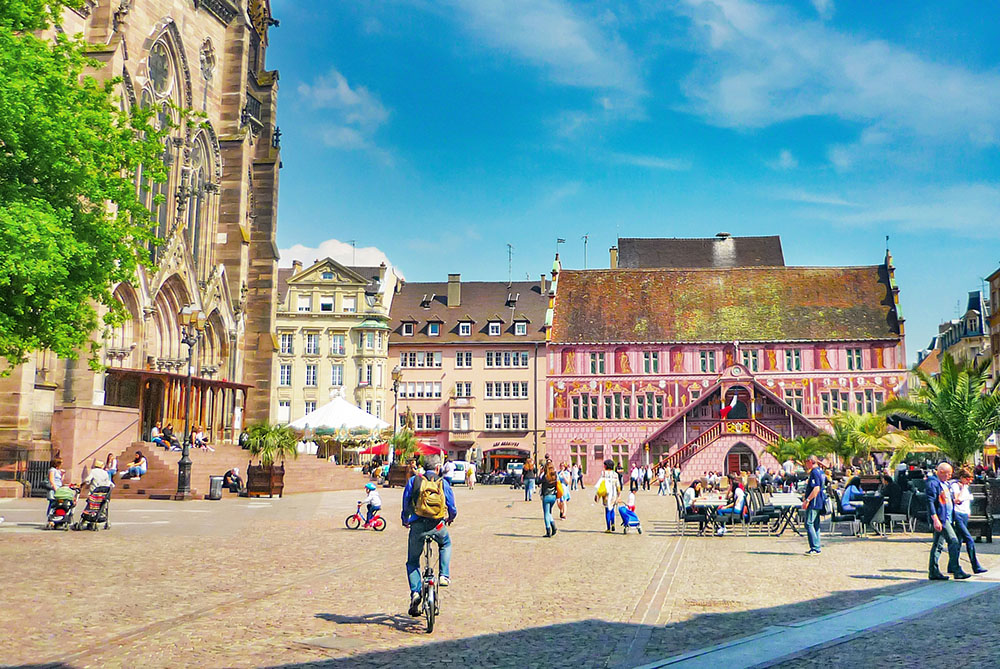

Place de la Réunion is the kind of square that catches you slightly off guard.
If you arrive in Alsace expecting only the obvious stars — Strasbourg, Colmar, perhaps a picture-perfect wine village — Mulhouse may not be the place you think of first.
And yet, right in the heart of the city, this richly coloured square has a personality all its own.
I know Place de la Réunion well. It is one of those places I never seem to tire of.
I have crossed it in every season, in bright summer light, on grey winter afternoons, during festive weekends, and in the quieter moments when the cafés are only just waking up.
Each time, it feels both familiar and full of detail: the painted façades, the neo-Gothic spire, the old town hall glowing in red and gold, the gentle sense that Mulhouse has never tried to imitate anyone else.
That is exactly why this square matters. Place de la Réunion is not simply a pretty urban space.
It is the historic heart of Mulhouse, a place where the city’s unusual past still shows in stone, paint, and civic pride.
The square’s name recalls the union of the former Republic of Mulhouse with France on 15 March 1798, and the setting still brings together many of the city’s most emblematic buildings.
If you are willing to look beyond the classic postcard version of Alsace, this is one of the most rewarding squares in the region.
Place de la Réunion: The Historic Heart of Mulhouse
The old town of Mulhouse is not especially large, and that is part of its charm.
Unlike the grand historic centres of Strasbourg or Colmar, it does not overwhelm you.
Instead, it reveals itself through a compact network of streets, and Place de la Réunion sits right at the centre of it all.
The square opens onto several streets of the old town, including rue Mercière, rue de la Lanterne, rue Henriette, Place Lambert, and the passage by the old town hall.
That explains why it always feels alive.
People cross it on their way somewhere else, stop there for coffee, linger on a bench, meet friends under the tower, or simply pass through and end up staying longer than expected.
What I love most is the overall impression.
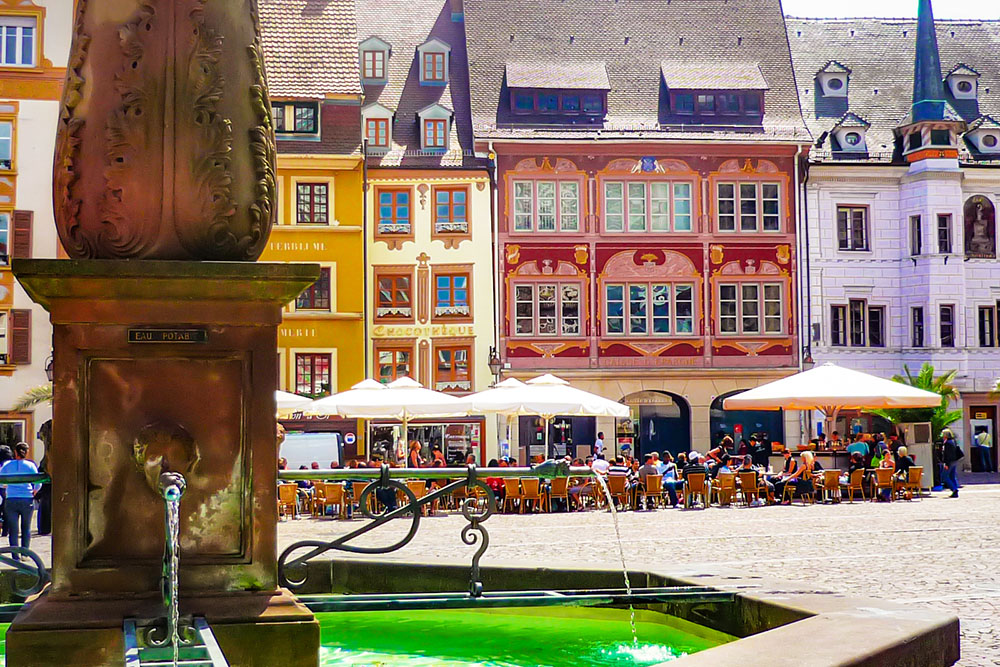
There is something distinctly Rhenish here, with a touch that almost feels Swiss rather than purely Alsatian.
The square is framed by painted façades, Renaissance forms, and civic buildings that tell you immediately that Mulhouse followed a different historical path from many other towns in the region.
The Mulhouse Tourist Office describes the historic centre as a human-scale area studded with architectural wonders and attractive alleys, and Place de la Réunion is where that character is most concentrated.
Why Place de la Réunion Feels Different from Other Alsace Town Squares
Many travellers come to Alsace searching for timbered houses, flower boxes, and village charm. Mulhouse offers a different mood.
Place de la Réunion feels more urban, more civic, and in some ways more self-assured.
It is not trying to charm you with medieval quaintness alone.
Instead, it presents a more complex face: a city square shaped by trade, Protestant history, Swiss alliances, Renaissance civic pride, and later French identity. That is what makes it memorable.
In Colmar, you often feel wrapped in a picturesque setting.
In Strasbourg, you feel the weight of a great European city.
In Mulhouse, on Place de la Réunion, you feel the pulse of a city that grew differently and is perfectly comfortable with that difference.
Place de la Réunion and the Buildings That Define It
One of the great pleasures of the square is that you can stand in one spot and read centuries of Mulhouse history around you.
The main monuments are not scattered across a vast city centre. They gather here, in conversation with one another.
The Temple Saint-Étienne
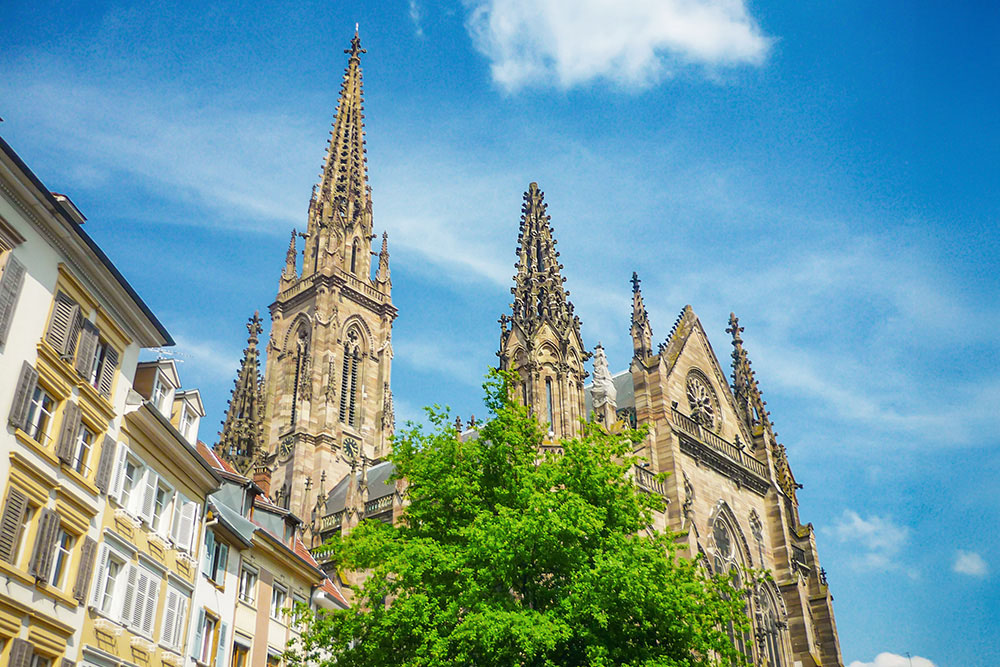
The most striking landmark on Place de la Réunion is undoubtedly the Temple Saint-Étienne.
Despite its Gothic appearance, the present Protestant church is relatively recent by Alsatian standards.
It was built between 1858 and 1868 in the Neo-Gothic style by the architect Jean-Baptiste Schacre, on the site of a much older church.
Its spire rises to 97 metres, making it the highest Protestant steeple in France.
The church also preserves remarkable stained-glass windows from the earlier medieval building, considered among the finest in the Upper Rhine region.
What I find so compelling about the temple is the way it dominates the square without crushing it.
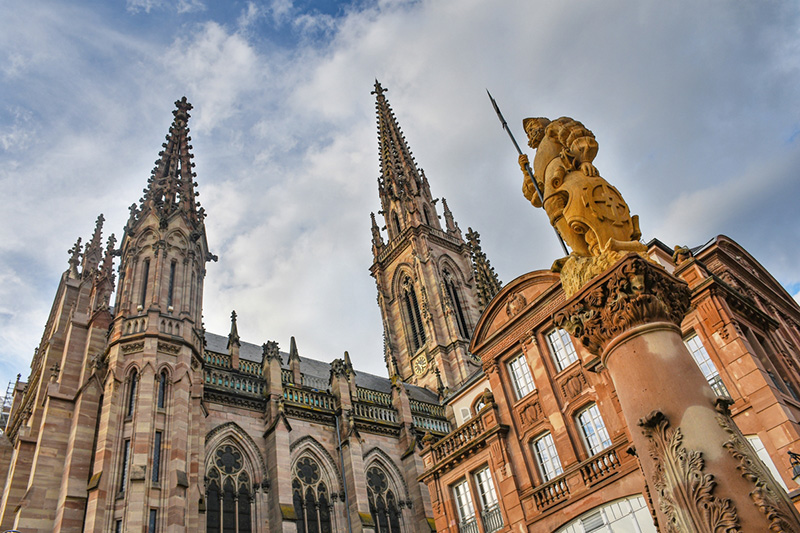
Its height gives Place de la Réunion a dramatic vertical accent, yet the building still feels part of the square’s overall balance.
Seen from below, the spire draws your eyes upward; seen from across the square, it anchors the entire composition. It is a church that gives Mulhouse confidence.
The Old Town Hall on Place de la Réunion
If the temple gives the square height, the old town hall gives it colour, ceremony, and civic character.
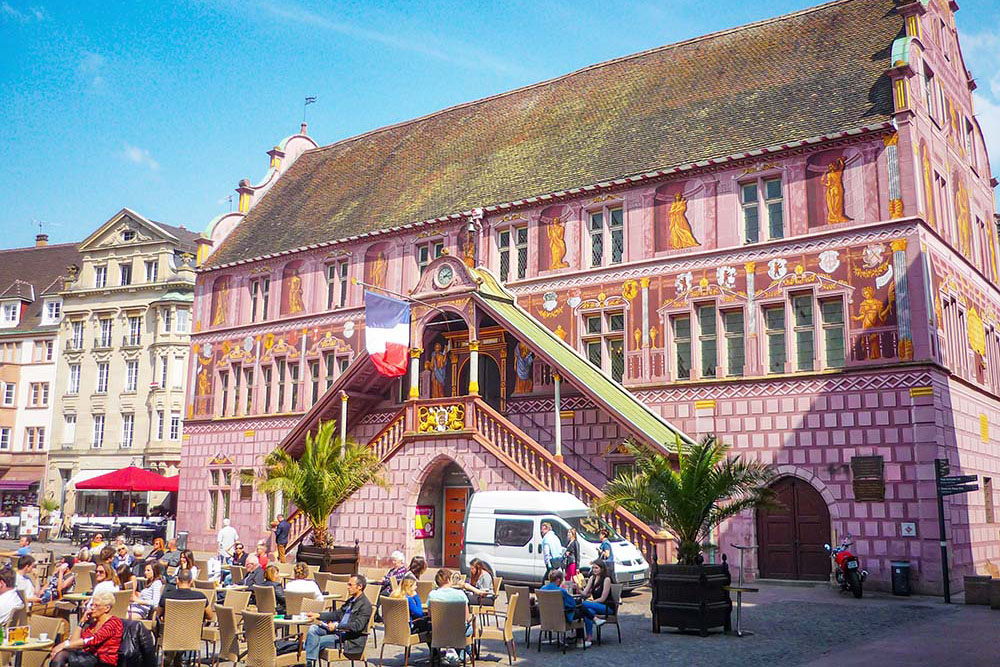
The present building was reconstructed in 1552–1553 after a fire destroyed the earlier town hall.
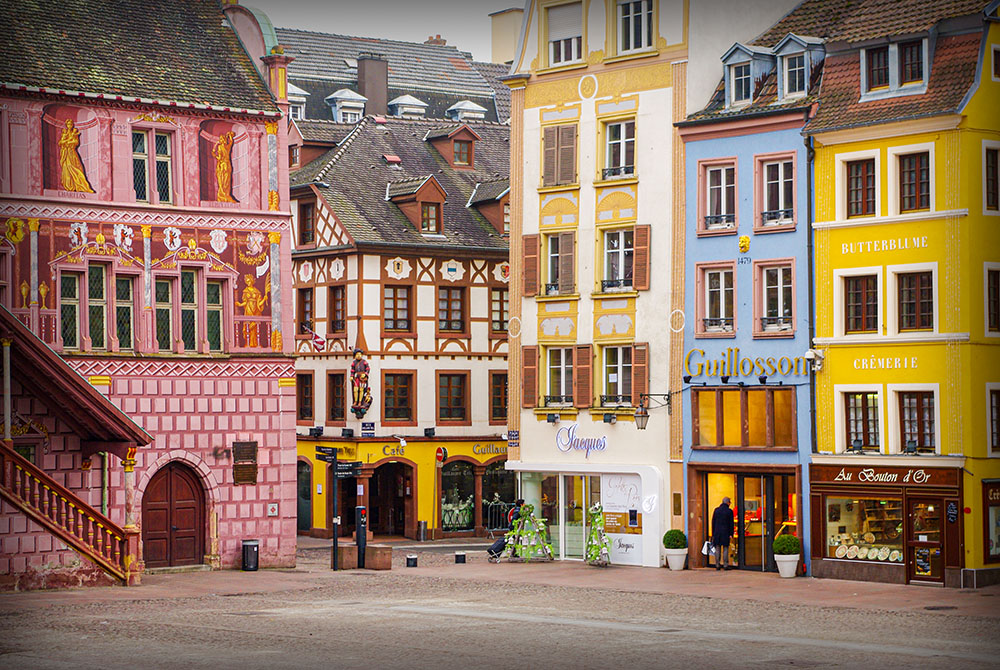
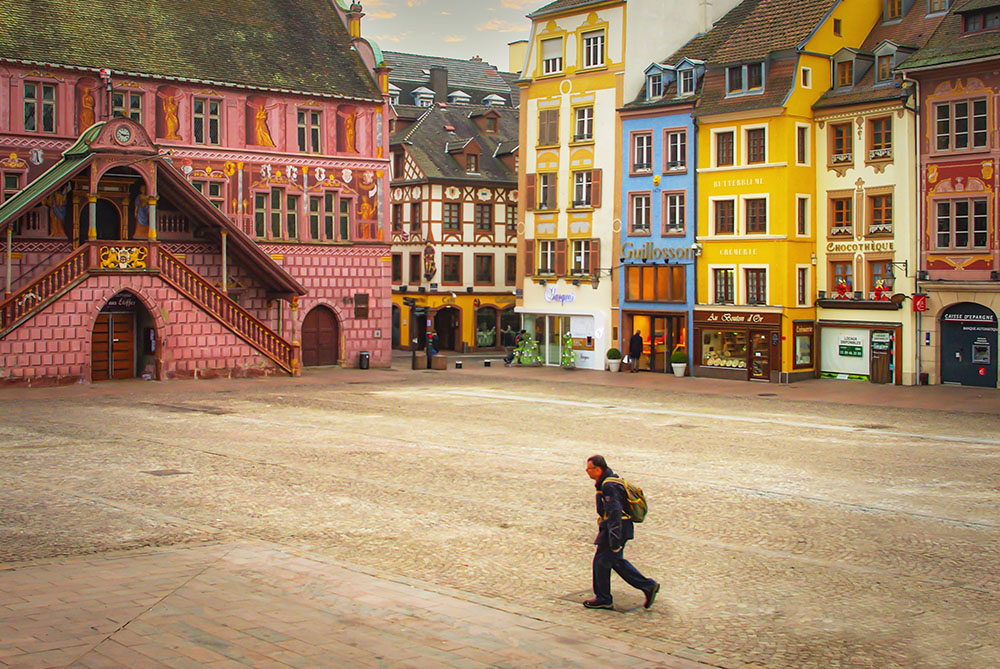
It is one of the finest examples of Rhenish Renaissance architecture in Alsace, with voluted gables and a slightly off-centre covered double staircase crowned by a small belfry.
Its red-and-gold painted decoration became one of the visual signatures of the square, and today the building houses Mulhouse’s Historical Museum.
Montaigne, passing through the city in 1580, reportedly described it as a “magnificent palace all in gold.”
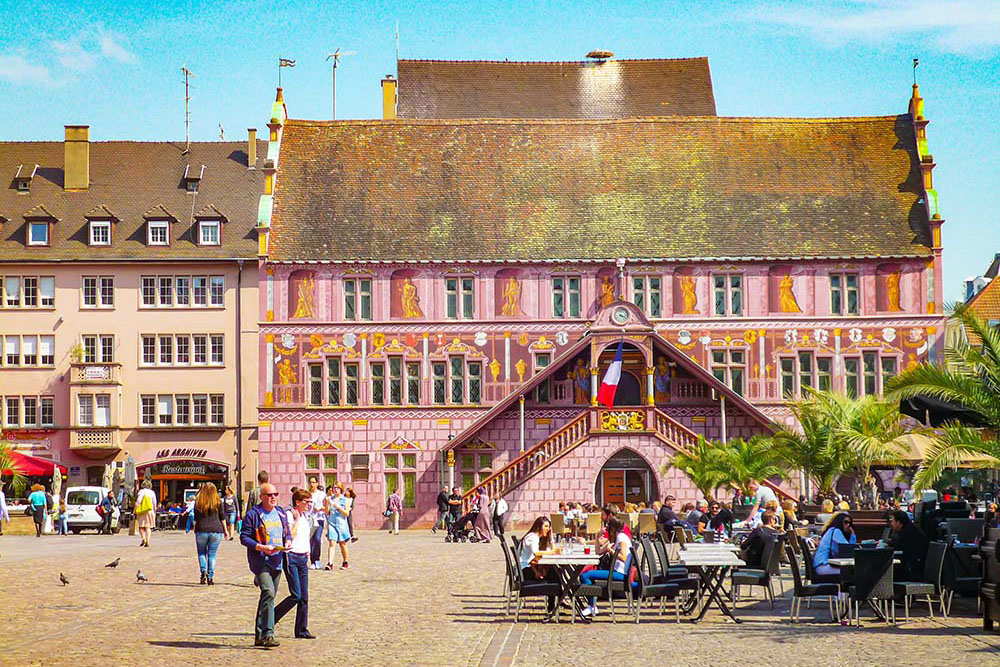
This is my favourite façade on Place de la Réunion. It has a theatrical quality, but also warmth.
It is not merely a handsome old building; it is a statement of civic pride from the days when Mulhouse was still a free city allied with the Swiss cantons.
The more you know about the square, the more this building begins to feel like the key to everything.
Maison Mieg and the Painted Houses
One of the most beautiful things about Place de la Réunion is that its architectural richness does not stop with the major monuments.
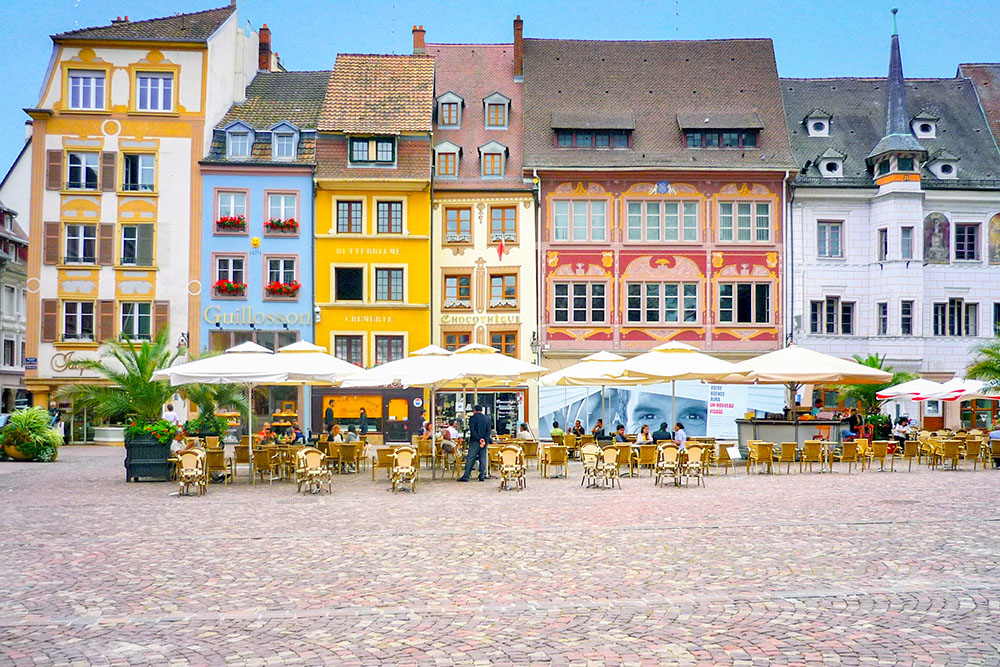
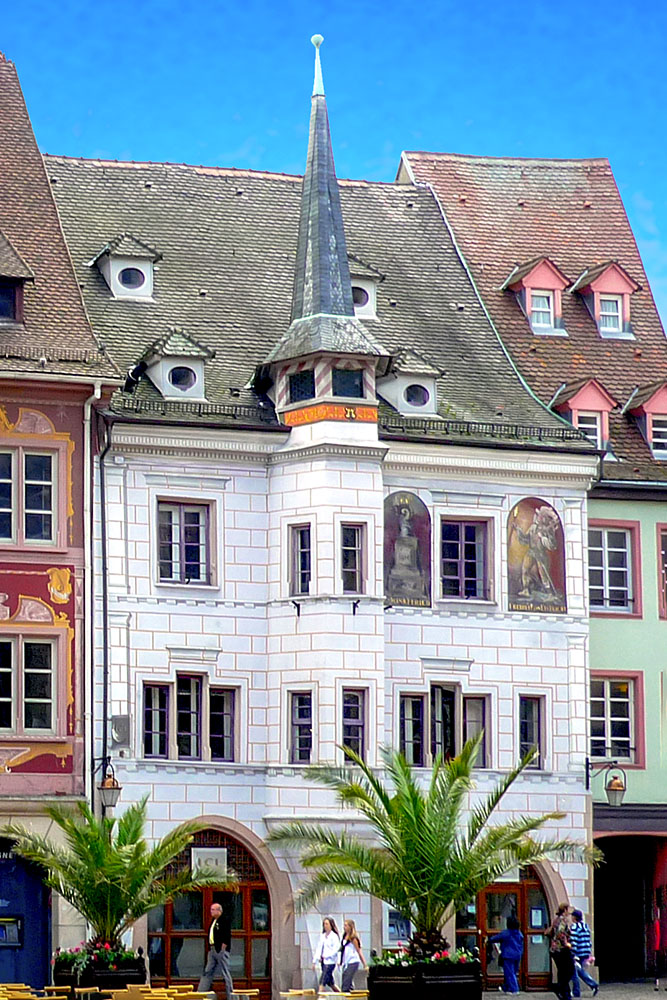
The surrounding houses matter too, especially Maison Mieg.
Maison Mieg is one of the most important historic houses on the square.
It is mentioned as early as 1418, was probably rebuilt around 1560, and later acquired the appearance by which it is known today.
Its painted trompe-l’œil façade, as well as the upper windows, echo the visual language of the town hall, while later additions gave the house even more personality.
This is one of the reasons Place de la Réunion feels so coherent.
The square is not defined by one single monument but by a whole family of façades.
Maison Mieg helps create that sense of a painted civic stage set, where every building seems to respond to the next. Nearby, the former tailors’ guild and the old pharmacy add yet more layers to the square’s visual texture.
Therefore, the Maison Mieg and the richly ornamented former town hall are central to the square’s appeal.
The Hallebardier Fountain on Place de la Réunion
Then there is the fountain, slightly set back, easy to overlook at first glance, and all the more charming for it.
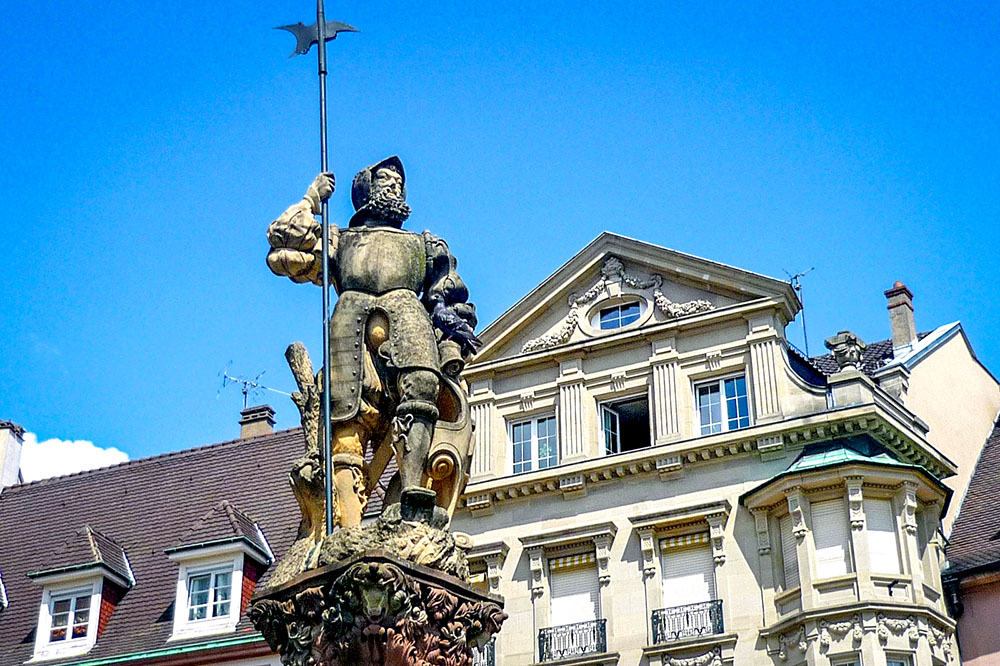
The fountain on Place de la Réunion is topped by a halberdier standing above the city’s arms.
It is one of those details that quietly completes the square. Not the main attraction, perhaps, but exactly the sort of feature that makes a historic place feel inhabited by memory rather than reduced to monuments alone.
I have always liked the way the halberdier punctuates the square.
He stands there as if keeping watch over the old Republic of Mulhouse, the painted façades, the passing crowds, and the long history gathered in this one urban space.
Why Is It Called Place de la Réunion?
The name Place de la Réunion is not decorative. It is historical, and it says a great deal about Mulhouse.
The term “Réunion” refers to the incorporation of the Republic of Mulhouse into the French Republic on 15 March 1798.
Before that date, Mulhouse had a highly unusual status: it had long maintained a distinct political identity and had been allied with the Swiss Confederation.
The square’s very name preserves the memory of that turning point.
That gives the square a depth many visitors may not expect.
It is not only the centre of the old town. It is a place where Mulhouse’s political story is written into the map itself.

A Square That Tells the Story of Mulhouse
This is what makes Place de la Réunion so much more than a photogenic square.
Stand here for a moment, and you can almost read the whole city through it: the free city, the Swiss links, the Protestant tradition, the Renaissance civic pride, the later French chapter, and the distinctly urban identity that would eventually shape industrial Mulhouse.
Few public squares tell the story of a city so clearly in their buildings, their name, and their atmosphere.
That is why I think this square deserves more than a quick look. It deserves attention.
Place de la Réunion at Christmas
If you visit Mulhouse in Advent, the Place de la Réunion changes mood completely.
The square hosts the Mulhouse Christmas Market, and in winter, it becomes one of the city’s most festive and atmospheric settings.
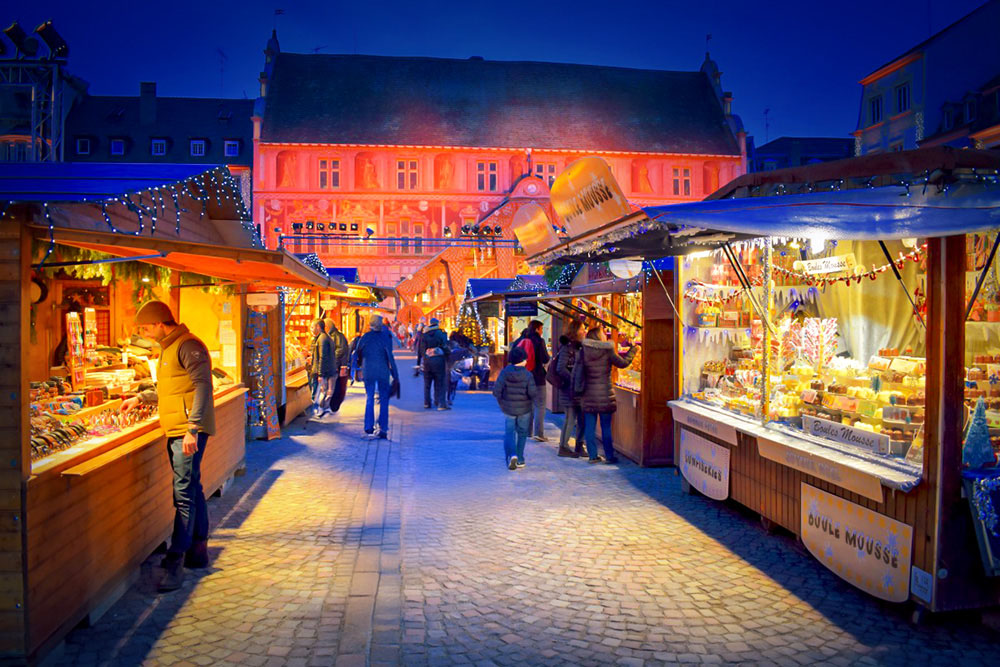
Locals gather there in summer for drinks on terraces and in winter for the Christmas market and seasonal events.
As night falls, the square turns magical with lights, chalets, and the festive energy that Christmas brings to Alsatian town centres.
This is one of the best times to feel how alive the square really is.
It is not a museum piece. It is still a shared space, still part of the city’s everyday life and celebrations.

Practical Tips for Visiting Place de la Réunion
Place de la Réunion is very easy to include in a visit to Mulhouse.
The historic centre is compact and can be explored on foot, and the square makes the ideal starting point for wandering into the surrounding streets.
The Tourist Office also points visitors toward walking routes through the old town and notes that the centre is easy to explore on foot or by bike.
For photography, I especially like the square in bright weather, when the colours of the façades really come alive.
Summer is wonderful for café terraces and atmosphere.
Winter, of course, brings the Christmas market. But even outside the main seasons, Place de la Réunion rewards a slow visit.
Do not just glance at the temple and move on.
Walk around the square.
Look up at the painted façades.
Step back to take in the town hall.
Then wander into rue Mercière or rue des Boulangers and let the old centre continue to unfold.
Final Thoughts on Place de la Réunion
There are places that impress instantly, and there are places that stay with you.
For me, Place de la Réunion belongs to the second category.
It may not be the most famous square in Alsace, but it has something rare: a strong identity that feels inseparable from the city around it.
The temple, the old town hall, the Maison Mieg, the halberdier fountain, the painted façades, the name itself — all of it comes together to form a square that is unmistakably Mulhouse.
And perhaps that is why I keep coming back to it.
Not because it tries to be a postcard version of Alsace, but because it offers something more distinctive.
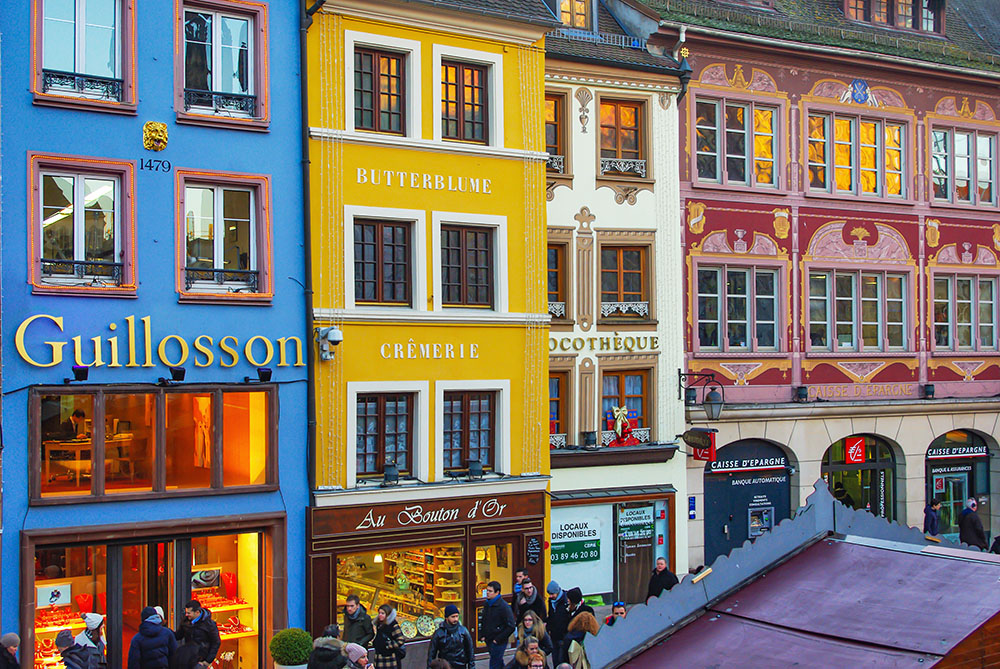
Place de la Réunion is lively, colourful, historical, and deeply rooted in the city’s singular past.
In other words, it is exactly the kind of place worth lingering in.
You can read more about Place de la Réunion in French on our blog!