
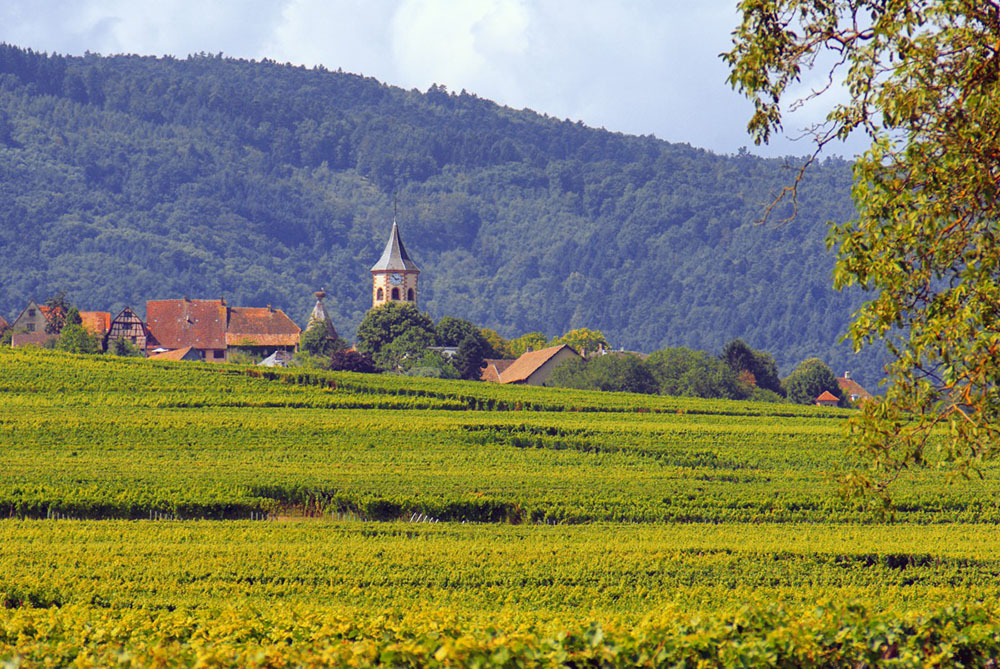

Zellenberg, Alsace is a small wine-growing village perched on a hill between Riquewihr and Ribeauvillé, along the famous Alsace Wine Route.
For years, I had admired this little village from the road without ever stopping to explore it.
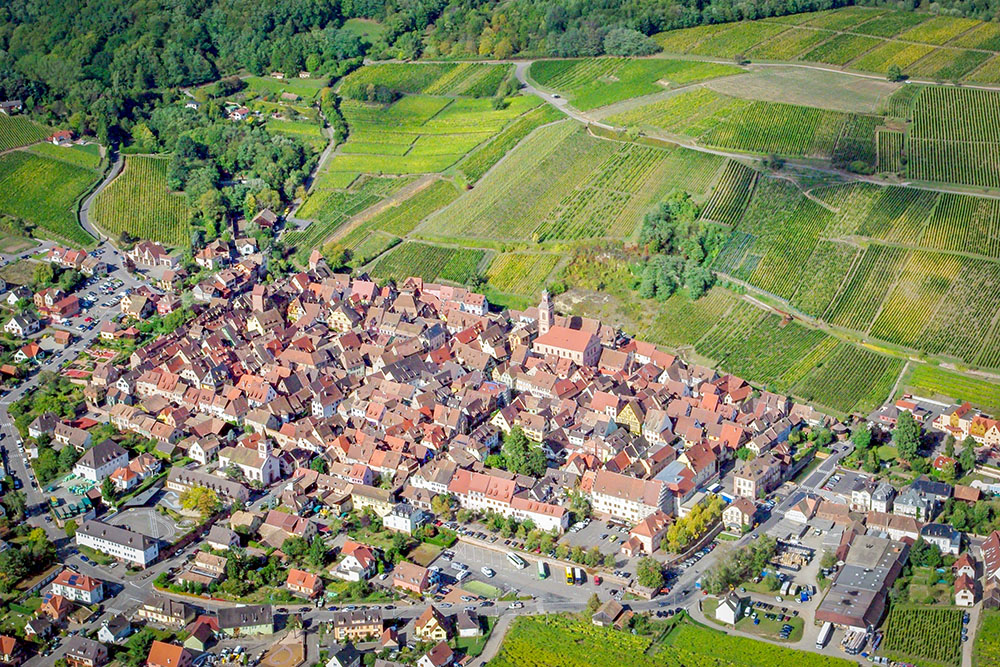
When driving north from Colmar towards Ribeauvillé, it is difficult not to notice Zellenberg. Its tightly packed houses rise above the surrounding vineyards, with the Vosges mountains forming a beautiful backdrop.

Unlike many Alsatian villages that lie at the foot of the mountains, Zellenberg occupies a hill of its own.
And that makes it rather special.
One summer, I finally decided to stop and have a look.
I was expecting something similar to Riquewihr or Kaysersberg, with rows of colourful half-timbered houses and picturesque streets.
Well, not quite!
Zellenberg certainly has some interesting historic buildings, but what impressed me most was its position overlooking the vineyards.
The views are magnificent.
And, as I soon discovered, this little village has a few interesting stories to tell.
Where is Zellenberg in Alsace?
Zellenberg is located in the Haut-Rhin department of Alsace, in northeastern France.
It stands between two of the region’s best-known wine towns, Riquewihr and Ribeauvillé, approximately 15 kilometres north of Colmar.
The village occupies a hill rising to an altitude of 285 metres, surrounded by vineyards on almost every side.
With around 400 inhabitants, it is one of the smaller communities along this part of the Alsace Wine Route.
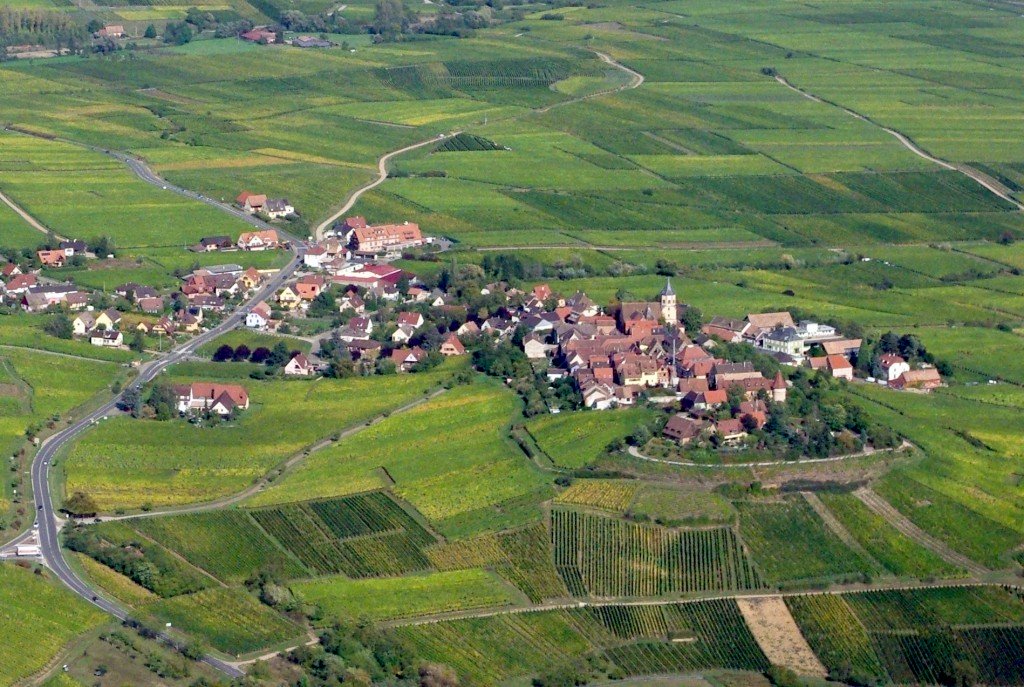
Its historic centre is surprisingly compact.
Two main streets, Rue du Schlossberg and Rue de la Fontaine, run almost parallel between the church square and the upper end of the village.
You can explore the old streets without spending hours here.
However, I would strongly recommend allowing some additional time to walk through the surrounding vineyards.
That is where you will find some of the finest views.
Zellenberg: A Little History Before Our Walk
Have you ever wondered what the name Zellenberg means?
Like many place names in Alsace, it has Germanic origins.
The word Zell refers to a monastic cell or hermitage, while Berg means mountain or hill.
Zellenberg can therefore be interpreted as the Hill of the Hermitage.
The history of the settlement goes back many centuries.
According to local historical accounts, monks from the Abbey of Luxeuil established a small religious community here during the 10th century.
A village gradually developed around the sanctuary.
Then, in 1252, Walter III of Horbourg built a castle on the hill.
It was a sensible choice.
From this elevated position, the castle commanded excellent views across the vineyards, the Alsace Plain and the foothills of the Vosges.
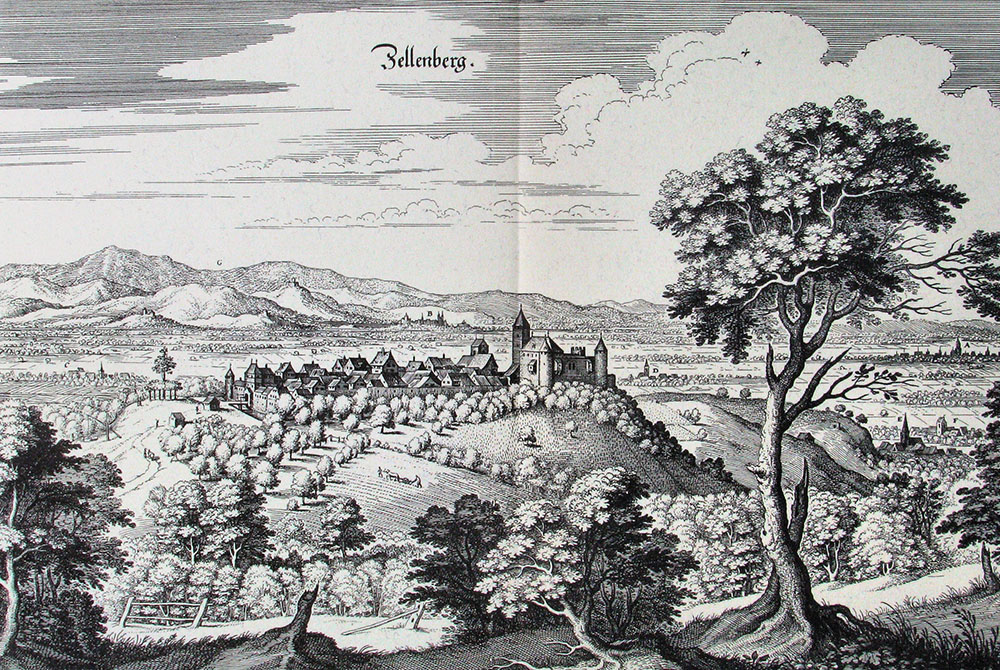
In medieval times, such a vantage point had obvious military advantages.
By the early 14th century, Zellenberg had become a fortified settlement surrounded by defensive walls.
Four towers protected the corners of its approximately rectangular enclosure.
Two of these medieval towers have survived.
The castle, however, has disappeared.
By the late 18th century, the fortress had fallen into ruin. Its stones were subsequently recovered for use as building materials.
A rather unfortunate end for a castle that had watched over the surrounding countryside for hundreds of years!
But enough history for now.
Let me take you through the old village.
What to See in Zellenberg Alsace
1. Saint-Ulrich Church and Its Unusual Bell Tower
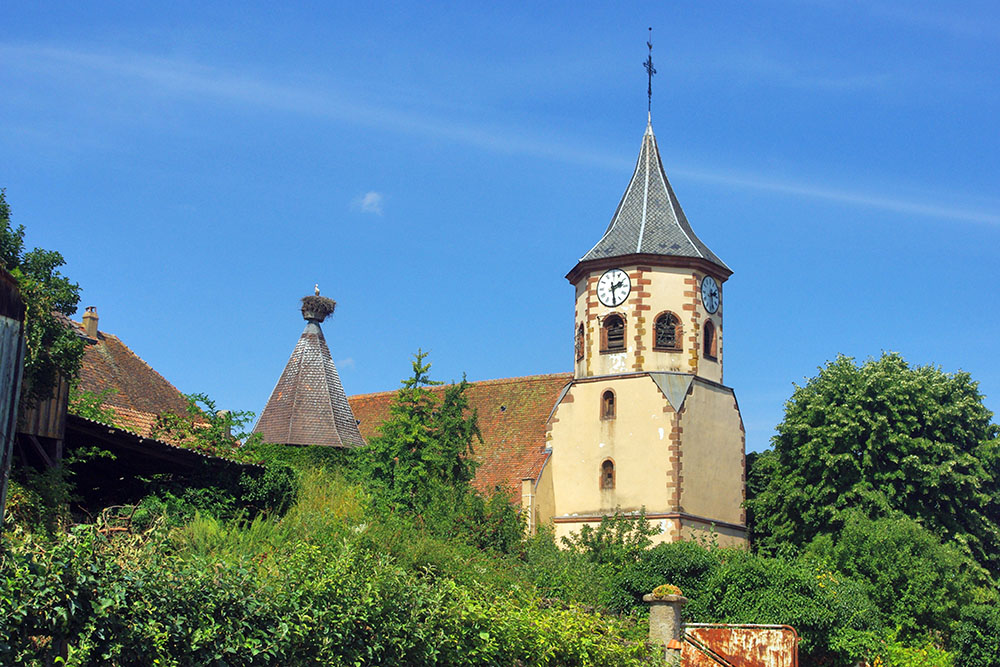
I began my visit at the church square, near the entrance to the historic village.
Saint-Ulrich Church dates from 1760 and replaced an earlier place of worship.
Its architecture has an unusual feature.
In many Alsatian villages, the church tower stands above the main entrance.
Here, however, the small octagonal tower rises above the choir, at the opposite end of the building.
The bell dates from 1410, making it one of the oldest in Alsace.
Unfortunately, the church was closed when I visited.
I was therefore unable to see the interior, which contains a 15th-century polychrome wooden Pietà and several historic paintings.
Nevertheless, the exterior is worth examining, particularly when viewed from the surrounding vineyards.
2. The Medieval Tower with Its Stork’s Nest
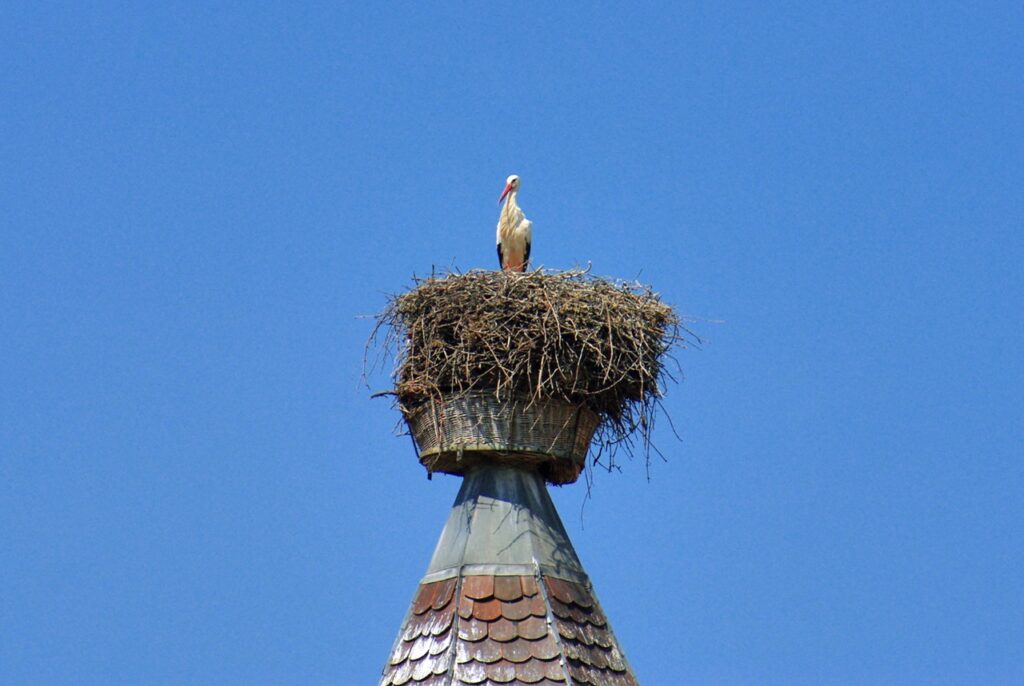
Beside the church stands one of Zellenberg’s most recognisable landmarks.
It is a round medieval tower, crowned with a conical roof.
Built around 1315, the structure formed part of the village’s defensive walls.
But it is not simply the medieval architecture that attracts attention.
At the top of the tower, a stork has made its nest!
Now, if there is one bird closely associated with Alsace, it must surely be the white stork.
You will see stork nests on church towers, chimneys and specially constructed platforms in many villages throughout the region.
Here in Zellenberg, the bird has chosen a medieval fortification as its home.
I rather like that.
The tower no longer protects the village from potential invaders.
Instead, it provides accommodation for one of Alsace’s most famous residents.
And what a view the storks must enjoy from up there!
3. Rue du Schlossberg: A Walk Through Old Zellenberg
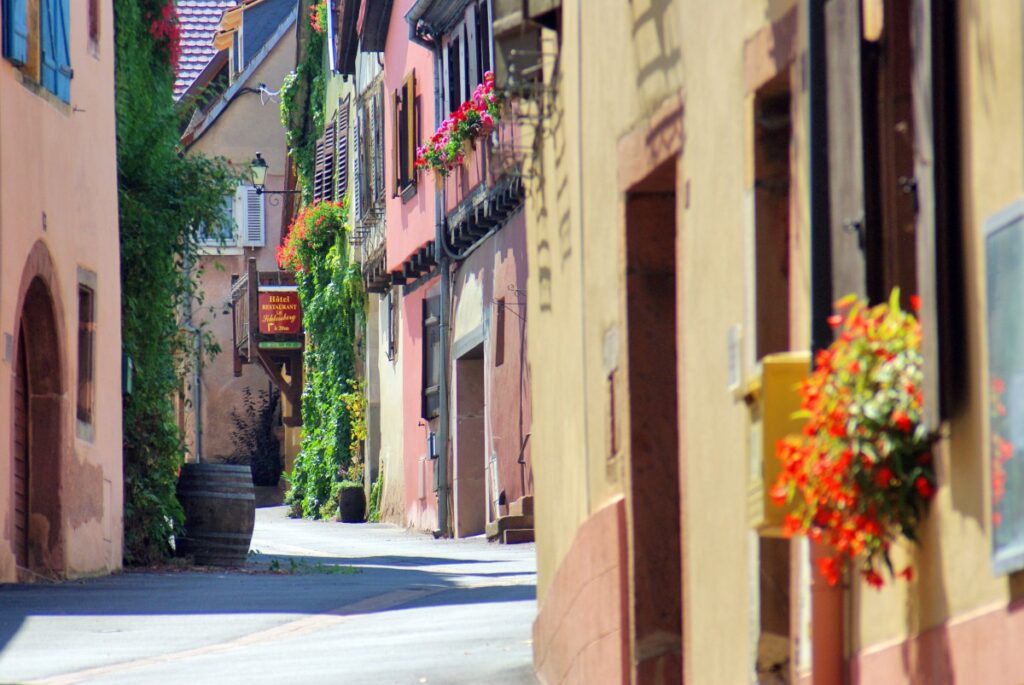
From the church, continue along Rue du Schlossberg.
This is one of the two principal streets of the old village.
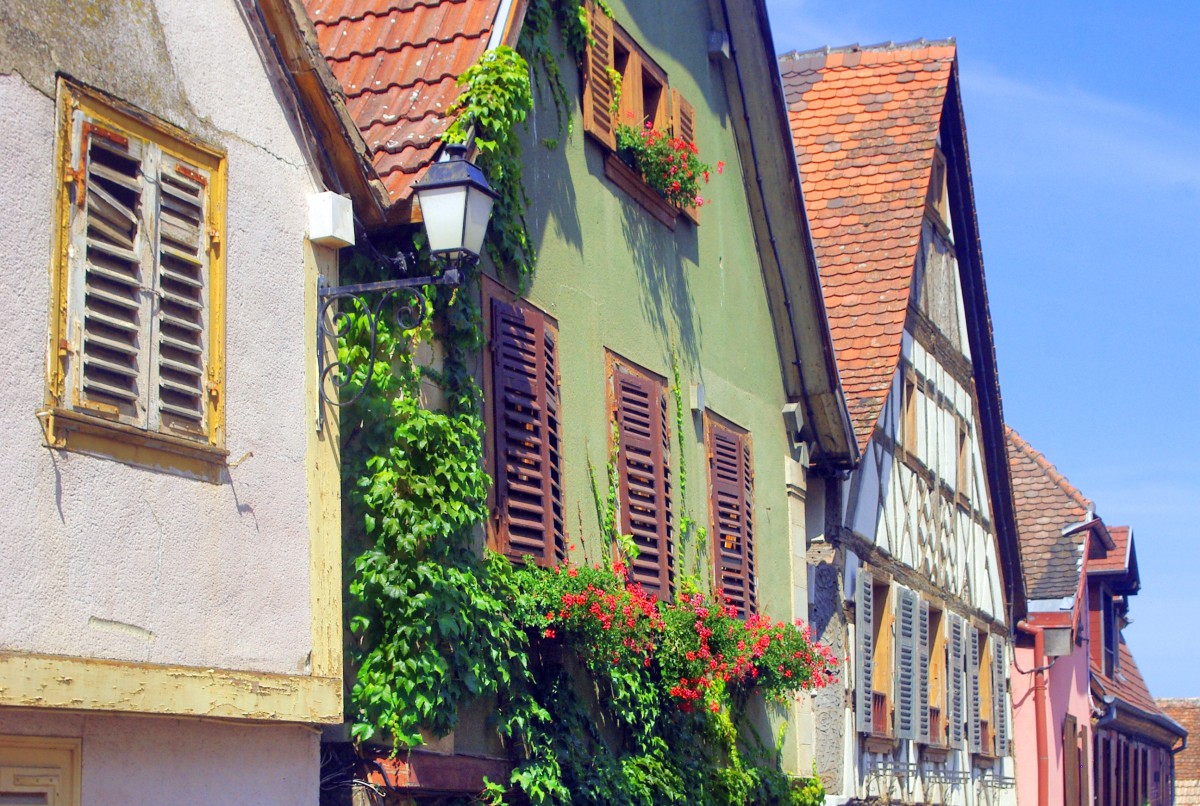
Although Zellenberg does not have quite the same concentration of elaborate timber-framed houses as Riquewihr, several buildings are worth a closer look.
At number 11 stands the former guardhouse, built in 1722.
The building once controlled movement into and out of the village.
Notice the old warning bell, which could be used to alert the population in an emergency.
At number 10, you will find the former communal meeting house, known as the Ratsstube.
Dating from 1490, it served as an early municipal building where the village council met to discuss local affairs.
The schoolteacher also lived here.
It is interesting to think that, more than five centuries ago, decisions affecting everyday life in Zellenberg were being made within these walls.
4. The Old Communal Bakehouse
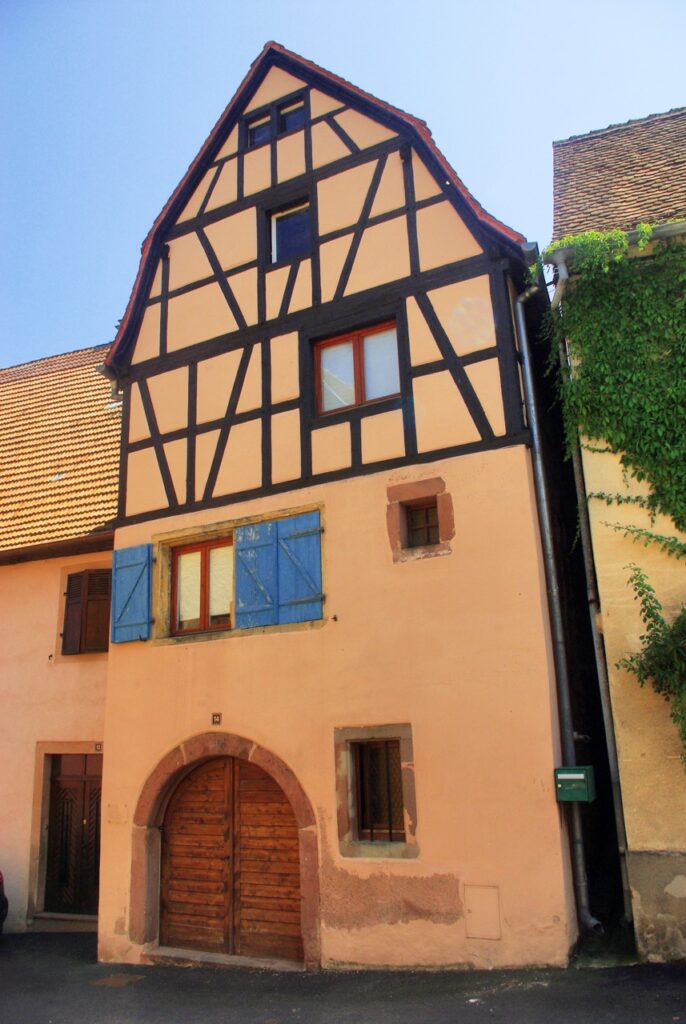
A little further along Rue du Schlossberg, at number 14, stands one of my favourite historic buildings in Zellenberg.
The former communal bakehouse dates from 1490.
Known as the Ofenhaus, it was an important part of village life.
In the past, not every household possessed an oven suitable for baking bread or preparing large dishes.
Instead, villagers could bring their food to the communal oven.
Bread, tarts and other specialities would be baked there.
Among them was probably baeckeoffe, one of Alsace’s most traditional dishes.
Baeckeoffe is a hearty casserole made with marinated meat, potatoes, onions and other vegetables.
The name comes from the Alsatian words meaning baker’s oven.
There is a connection with the traditional practice of taking a prepared casserole to the baker for slow cooking in the residual heat of the oven.
So the next time you enjoy a serving of baeckeoffe in an Alsatian restaurant, remember that the dish has its roots in the communal baking traditions of villages such as Zellenberg.
5. The Town Hall and Presbytery Under One Roof
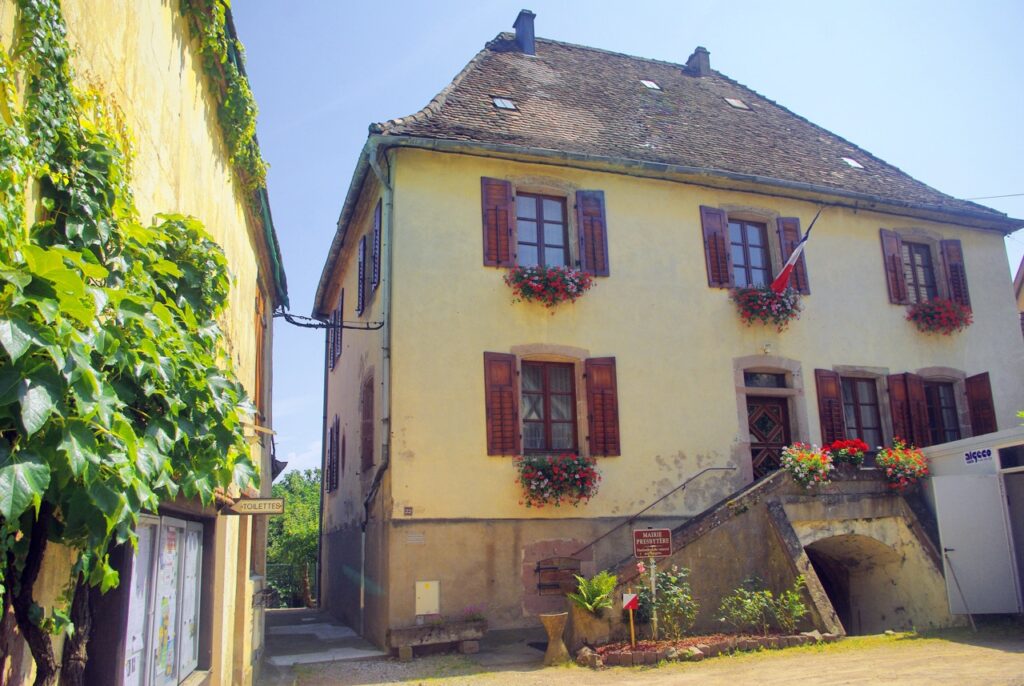
At number 22 Rue du Schlossberg, you will come across a rather unusual arrangement.
The town hall and presbytery occupy the same historic building.
A French town hall sharing premises with a religious institution?
That may sound surprising, particularly in a country known for its principle of laïcité, or the separation of religion and the state.
But there is a straightforward historical explanation.
Over the centuries, the building served several purposes, including a hospital and a winegrower’s residence.
It became a presbytery again in 1912.
Then, in 1994, part of the property was adapted to accommodate the municipal offices.
This was simply a practical solution for a small community.
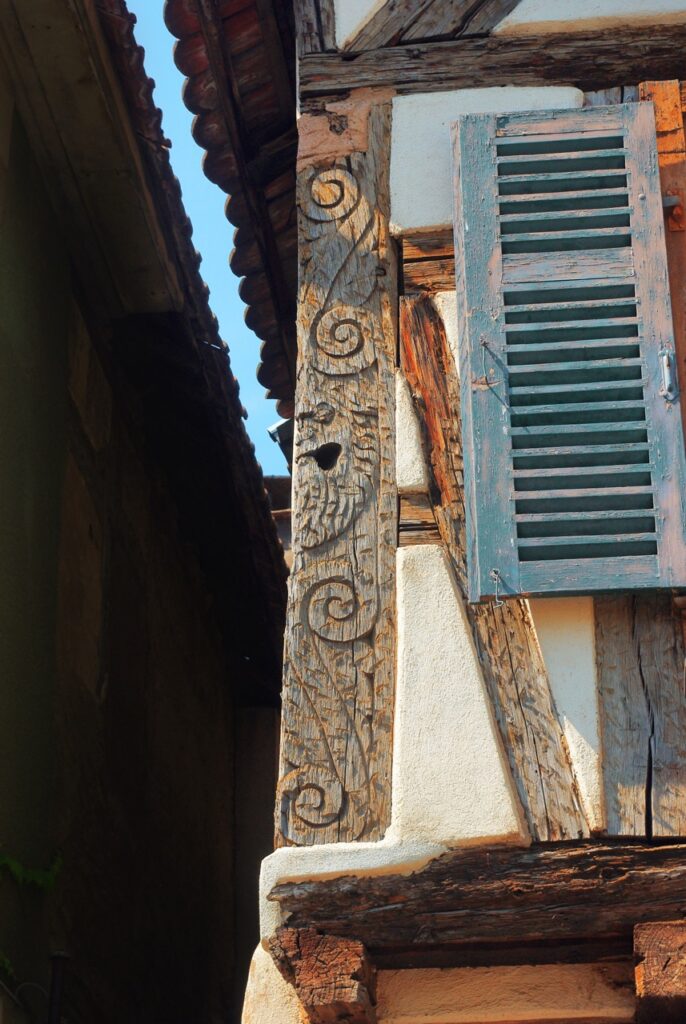
Opposite, at number 25, stands the former communal inn, dating from the 17th century.
Take a moment to examine its beautifully carved corner post.
Such architectural details are easy to overlook, especially when walking through a village for the first time.
6. Place du 19 Décembre 1944: A Tragic Chapter
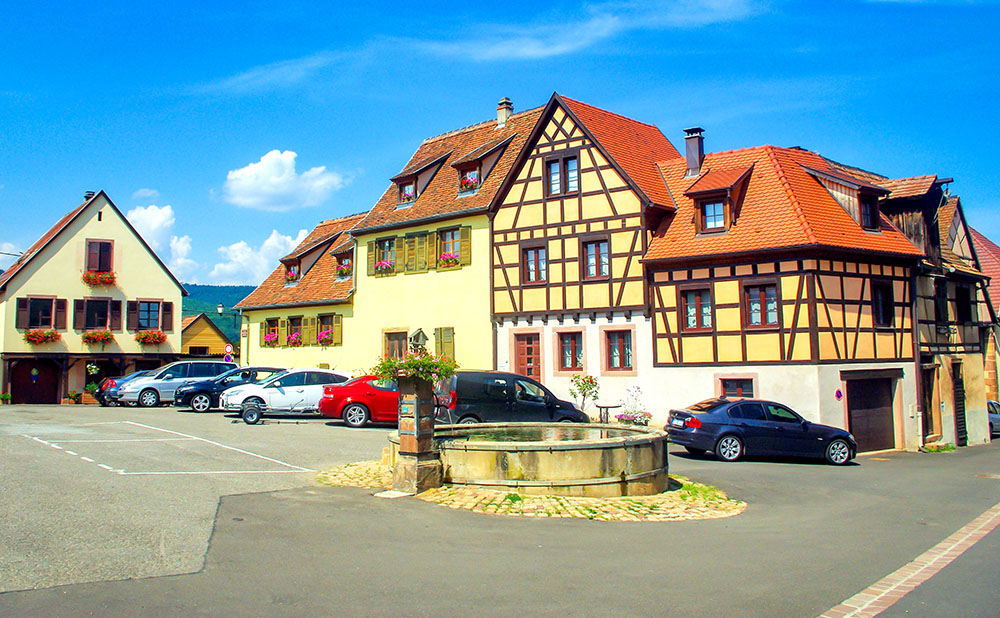
Continuing through the old village, you will reach a square with a rather unusual name.
Place du 19 Décembre 1944.
Why is this particular date remembered?
The answer takes us back to the final months of the Second World War.
American troops entered Zellenberg on 5 December 1944.
However, the liberation of the village did not mean that the fighting had ended in the surrounding region.
The Battle of the Colmar Pocket continued during the winter of 1944–45.
On 19 December 1944, a devastating fire destroyed seven houses in the upper part of Zellenberg.
A stock of ammunition was stored in the buildings, and explosions made the situation particularly dangerous.
The precise cause of the fire remains uncertain.
What is clear is that the explosions prevented immediate intervention and caused extensive destruction.
The present square occupies the site of the buildings lost in the disaster.
I find stories such as this important because they remind us that the liberation of Alsace was not a single event.
For many communities, the weeks and months surrounding liberation remained extremely difficult.
7. The Second Medieval Tower and the Lost Castle
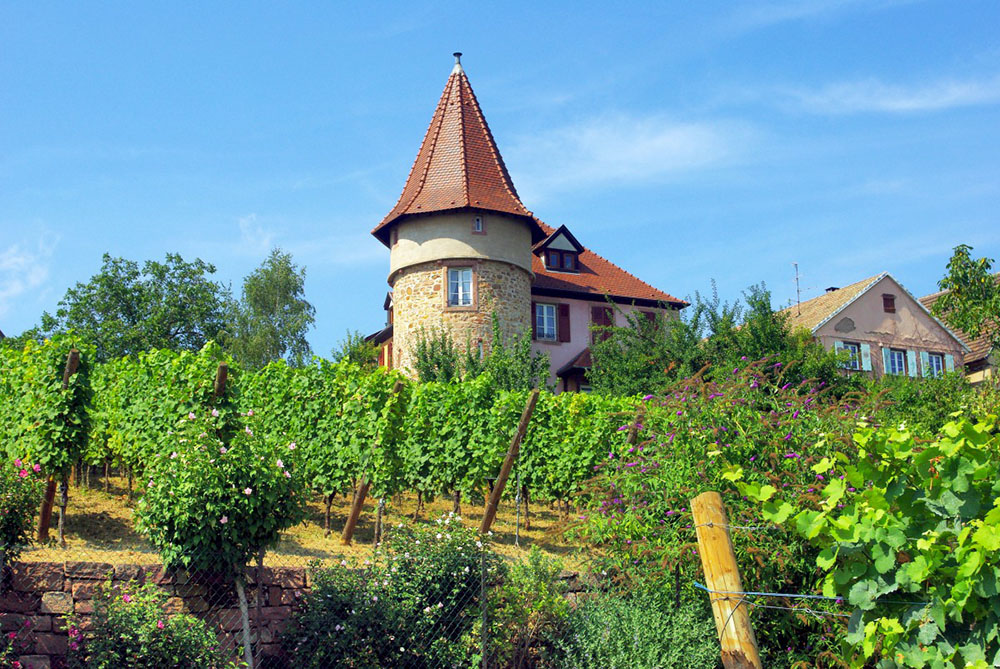
Towards the upper end of Rue du Schlossberg stands another surviving tower from the medieval fortifications.
It is located on private property at number 46.
Dating from the early 14th century, the tower was restored and heightened in 1992.
Not far away lies the former site of Zellenberg Castle.
The fortress was known as the Schlossberg, literally the castle hill.
Unfortunately, there is no castle left to explore.
Nevertheless, the position of the site explains why medieval lords were so interested in controlling this little hilltop settlement.
From here, they could watch over the surrounding vineyards and a considerable section of the Alsace Plain.
Walking Through the Zellenberg Vineyards
After exploring Rue du Schlossberg, you can return towards the church along Rue de la Fontaine.
This second street contains several other interesting old buildings.
Look out for the former communal stables at number 63, the clerk’s house at number 69 and the old sandstone fountain decorated with a small figure holding a bunch of grapes.
The fountain provides another reminder of the close relationship between Zellenberg and winegrowing.
But if you have time, I would recommend continuing your walk beyond the houses.
This is what I did during my visit.
And I certainly did not regret it.
The Dornerweg Path: My Favourite Part of Zellenberg
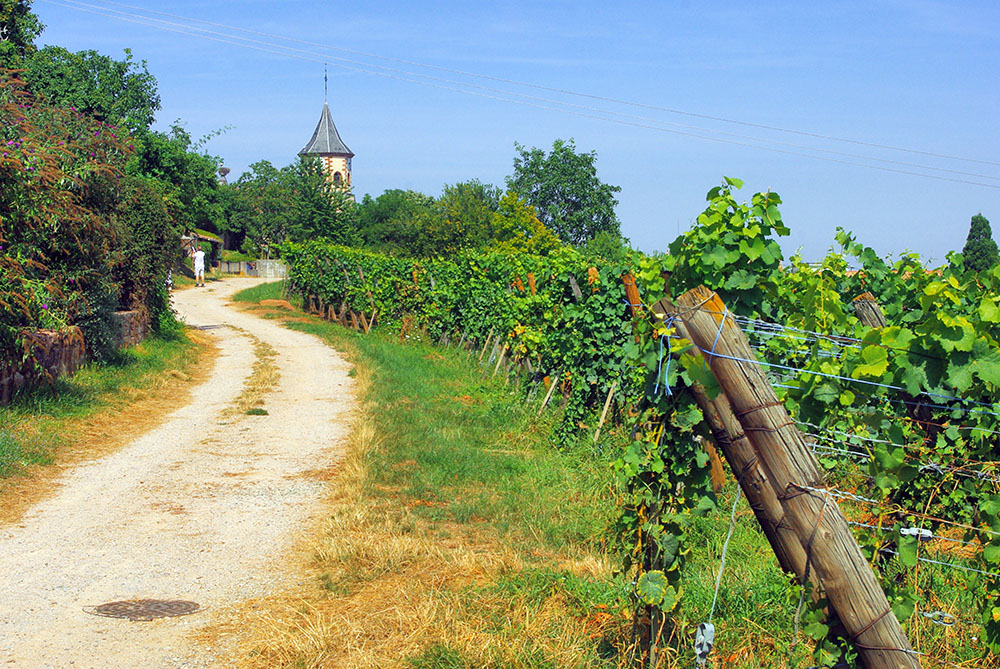
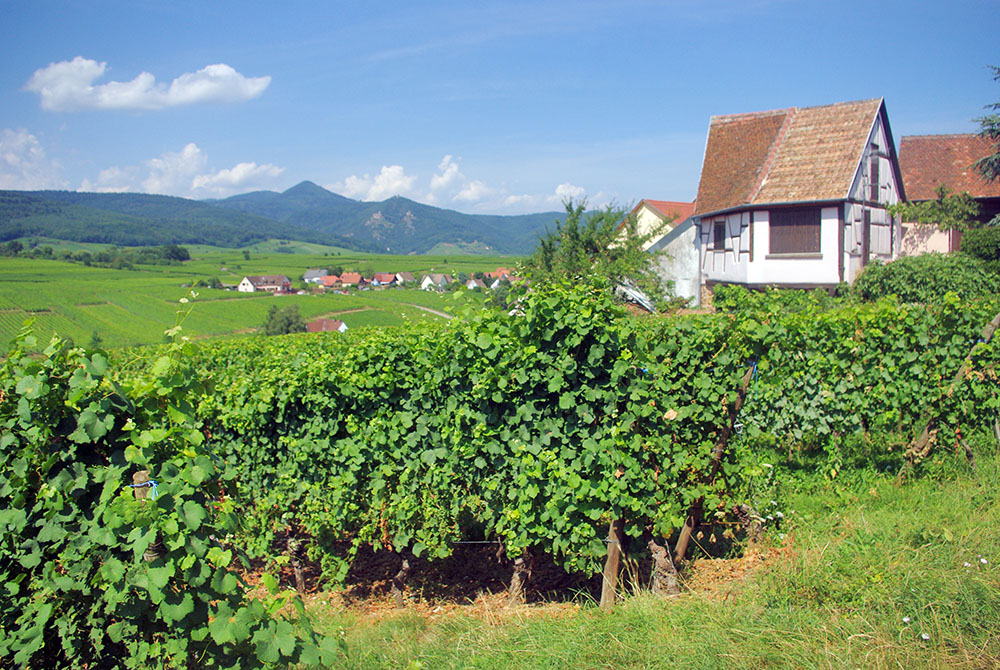
The Dornerweg is a path that follows the vineyards around part of the hill.
As you walk, the views change with almost every bend.
Looking towards the southwest, you can see Riquewihr nestling among the vineyards.
Further north, the three castles of Ribeauvillé rise above the town, on the wooded slopes of the Vosges.
The imposing silhouette of Haut-Kœnigsbourg Castle is also visible in the distance.
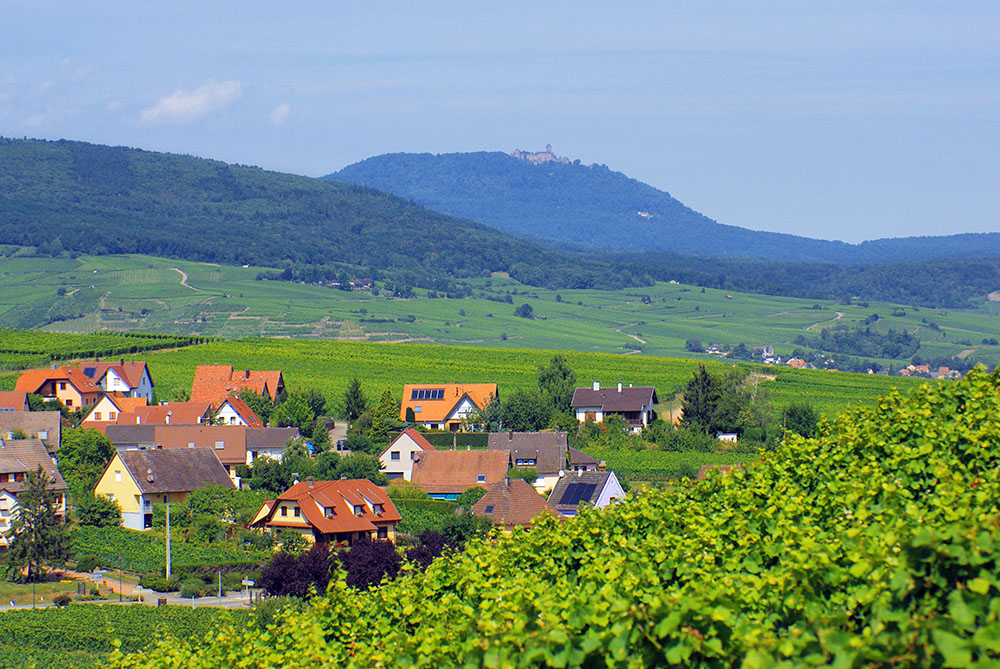
Turn towards the east, and the Alsace Plain stretches towards the River Rhine and Germany.
On a clear day, you can even make out the Black Forest beyond the plain.
From other viewpoints, the villages of Bergheim and the area around Sélestat come into sight.
For me, these panoramas are the greatest attraction of Zellenberg.
They also help explain the geography of the Alsace Wine Route.
To the west, the Vosges mountains provide a natural boundary.
To the east, the Rhine Plain extends towards Germany.
Between the two lies a narrow belt of gently sloping, vineyard-covered hills.
And Zellenberg occupies a wonderful position right in the middle of this landscape.
Zellenberg and Its Alsace Wines
It would be difficult to write about Zellenberg without mentioning wine.
After all, the village is almost completely surrounded by vineyards.
Winegrowing has played an important role in the local economy and traditions for centuries.
The vineyards around Zellenberg produce wines under several Alsace appellations, including Alsace AOC, Crémant d’Alsace and Alsace Grand Cru.
Two notable Grand Cru vineyard sites associated with the commune are Froehn and Schoenenbourg.
The slopes benefit from favourable exposure and local geological conditions.
Several wine producers are based in the village and surrounding area.
If you are interested in Alsatian wines, a visit to a local winegrower can provide another reason to stop in Zellenberg.
Do check tasting arrangements in advance, as some estates require appointments.
Practical Tips for Visiting Zellenberg Alsace
How long should you spend in Zellenberg?
If you simply want to explore the historic streets, allow approximately 30–45 minutes.
However, I would recommend setting aside at least one hour, preferably a little longer.
This will give you time to see the main monuments and enjoy a short walk around the vineyards.
The Dornerweg was the highlight of my visit, so I would not leave it out.
Where can you park in Zellenberg?
The church square, at the entrance to the old village, is a useful starting point for a visit.
This is where I began my own walk.
Check the local parking signs when you arrive, as parking arrangements may change.
Once parked, you can explore the village on foot.
When is the best time to visit Zellenberg?
Zellenberg can be visited throughout the year, although the appearance of the vineyards changes considerably with the seasons.
Spring brings fresh green shoots to the vines.
Summer offers long days and lush vineyard scenery.
Autumn is particularly attractive, when the vine leaves turn shades of yellow, orange and red.
Winter reveals the shape of the landscape more clearly, although the vineyards are bare.
For photography, I would favour a clear day when the surrounding hills and distant mountains are visible.
Is Zellenberg worth visiting?
Yes, particularly if you enjoy historic villages, winegrowing landscapes and panoramic views.
However, I would not recommend Zellenberg for exactly the same reasons as Riquewihr or Kaysersberg.
If your main interest is in streets filled with spectacular half-timbered houses and tourist shops, you may find Zellenberg rather modest.
But if you appreciate small historic places with interesting stories and beautiful surroundings, it makes a rewarding stop.
What to See Near Zellenberg
One of the advantages of Zellenberg is its location in the heart of the Alsace Wine Route.
Several well-known destinations are only a short distance away.
Riquewihr is one of the most famous wine villages in Alsace, celebrated for its colourful houses, medieval fortifications and beautiful old streets.
Ribeauvillé offers a larger historic centre, with fountains, half-timbered houses and three ruined castles overlooking the town.
Hunawihr is particularly interesting for its fortified church, which stands above the vineyards.
Bergheim has an impressive circuit of medieval walls and a pleasant historic centre.
And of course, Colmar makes an excellent base for exploring this part of Alsace.
If you are driving along the Wine Route, it is easy to include Zellenberg as a short stop between some of these more familiar destinations.
You can read my other guides to Riquewihr and the Ribeauvillé–Riquewihr region for more ideas.
Frequently Asked Questions About Zellenberg
Where is Zellenberg in France?
Zellenberg is a small village in the Haut-Rhin department of Alsace, northeastern France. It lies along the Alsace Wine Route, near Riquewihr and Ribeauvillé, approximately 15 kilometres north of Colmar.
What is Zellenberg famous for?
Zellenberg is known for its hilltop position among the vineyards, its medieval fortified towers, its historic winegrowers’ houses and its panoramic views over the Alsace Plain and the Vosges.
Can you visit Zellenberg on foot?
Yes. The historic village is compact and can easily be explored on foot. There are also walking paths through the surrounding vineyards, including the Dornerweg.
Does Zellenberg have a castle?
Zellenberg once had a medieval castle, constructed in the 13th century. The fortress was later abandoned and dismantled, and no substantial remains survive today. However, two towers from the former village fortifications are still standing.
Is Zellenberg close to Riquewihr?
Yes. Zellenberg lies approximately 2 kilometres from Riquewihr, making the two villages easy to combine in a visit to the Alsace Wine Route.
My Final Thoughts on Zellenberg
For many years, Zellenberg was simply that little village on the hill that I admired while driving through the Alsace vineyards.
I could easily have continued passing by without ever stopping.
But I am glad I finally took the time to explore it.
It may not have the same architectural splendour as some of its more famous neighbours.
Nevertheless, I enjoyed discovering its medieval remains, its old communal buildings and the stories associated with its streets.
Above all, I appreciated the magnificent views from the surrounding vineyards.
If you are travelling between Colmar and Ribeauvillé, look out for the cluster of houses rising above the vines.
That is Zellenberg.
And if you have an hour or so to spare, why not stop and discover it for yourself?
My tip: do not limit your visit to the village streets. Take the Dornerweg path through the vineyards. For me, that is where Zellenberg reveals its greatest charm.