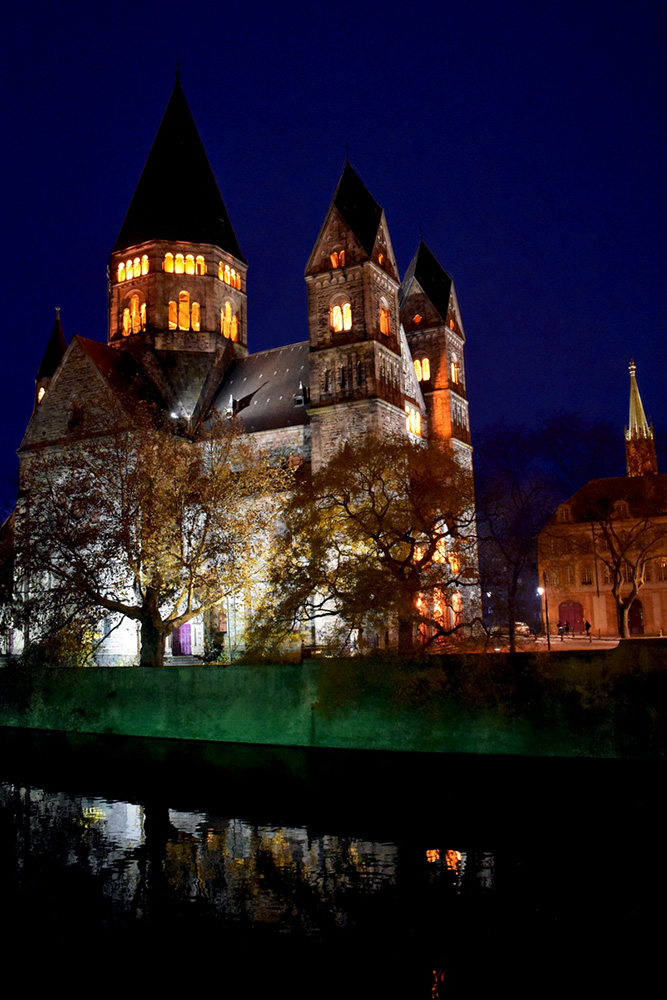
Temple Neuf is one of the most recognisable landmarks in Metz.
Standing on the Île du Petit-Saulcy, surrounded by the waters of the Moselle and the greenery of the Jardin d’Amour, it creates one of the most striking views in the city. If you have ever seen a postcard of Metz with a dark church reflected in the river, there is a good chance it was the Temple Neuf.
It is the kind of monument you think you know because you have seen it so many times.
And yet…
For a long time, I looked at it without really seeing it.
When I was a child, my paternal grandmother would sometimes take me into the centre of Metz. We often passed the Temple Neuf by bus, and I remember being impressed by its dark, massive silhouette. It looked old, important, almost mysterious. But in my mind, it was simply part of Metz.
There was the cathedral, the bridges, the shopping streets, the golden façades of Jaumont stone… and then there was this church.
Just another Metz landmark, I thought.
It was only much later, when I began to look into its history and architecture, that I realised the Temple Neuf was not at all a “normal” monument in the cityscape of Metz. In fact, it is almost an architectural anomaly.
An anomaly that, over time, has become one of the city’s emblems.
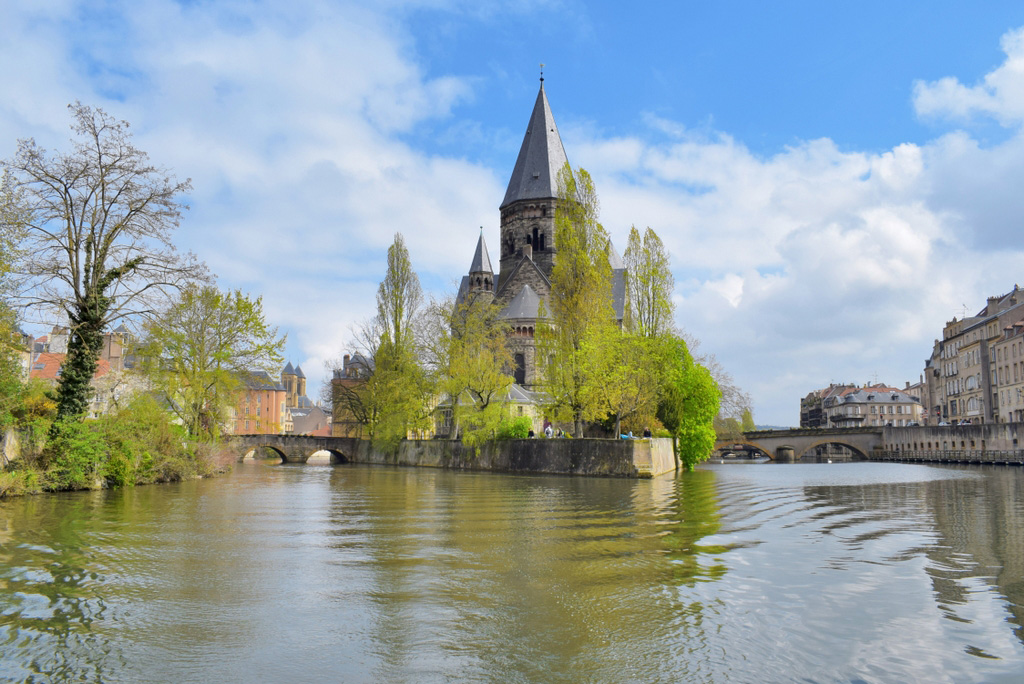
Table of Contents
Temple Neuf in Metz: A Familiar Silhouette with a Surprise
A childhood memory from the streets of Metz
I find it fascinating how certain monuments enter our memory without asking permission.
You see them as a child, you pass them in a bus or a car, you associate them with a street, a person, a family outing, and they quietly become part of your inner map.
For me, the Temple Neuf is linked to my grandmother and to those bus journeys through the centre of Metz.
Of course, at the time, I had no words for “Neo-Romanesque architecture”, “Wilhelmine period” or “German imperial urban planning”. I simply saw an impressive church with towers, dark stone and the look of a very old monument.
And that is where the misunderstanding begins.
Because the Temple Neuf looks ancient.
At first glance, you could easily imagine that it dates back to the Middle Ages, or at least to some distant chapter of the city’s history.
But no.
The Temple Neuf was completed in 1904.
That makes it much more recent than its appearance suggests. It is younger than many bourgeois buildings in the city centre, and far younger than the medieval and classical monuments around it.
Why I once saw the Temple Neuf as a “normal” Metz monument
When you grow up with a monument, you do not always question it.
You accept it.
It is like the landscapes of childhood: streets, bridges, church towers, squares and façades. They seem obvious because they were already there when you first opened your eyes to the world.
For a long time, that was how I saw the Temple Neuf.
It stood by the Moselle, near the Place de la Comédie, not far from the cathedral. It belonged to the city.
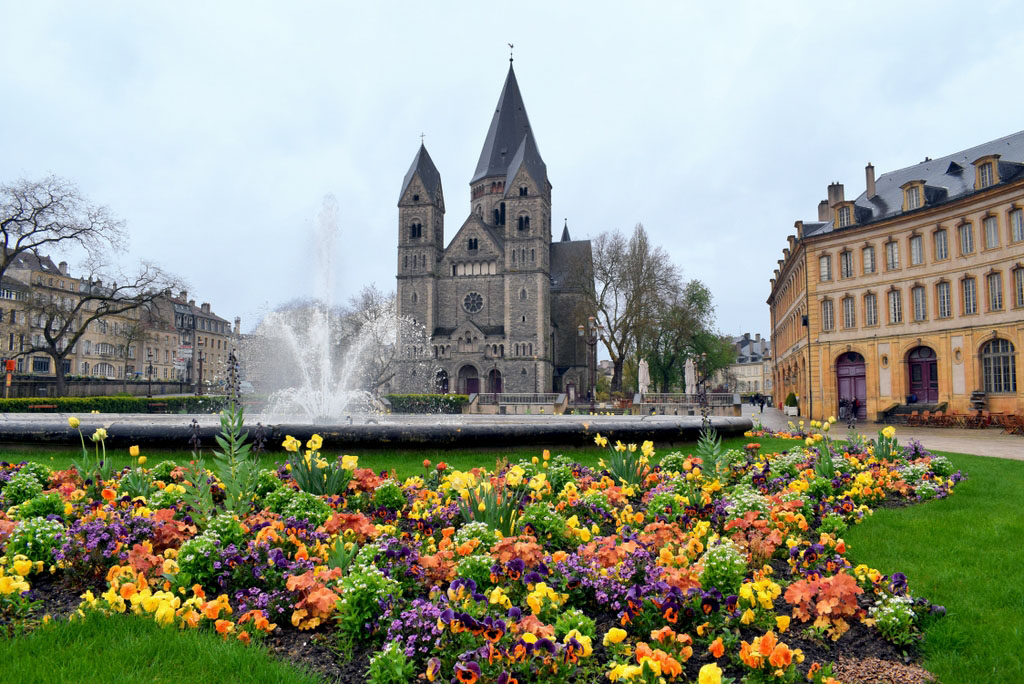
And yet, when you look more closely at Metz, one thing becomes obvious: the Temple Neuf stands apart.
It does not share the golden tone of Jaumont stone, so typical of the city. It does not speak the same architectural language as the elegant Opéra-Théâtre nearby. It does not try to blend into the classical harmony of the Place de la Comédie.
It comes from somewhere else.
Or rather, it expresses another layer of Metz’s history.
A German, imperial, Rhenish layer.
Where Is the Temple Neuf in Metz?
The Île du Petit-Saulcy and the Jardin d’Amour
The Temple Neuf stands on the Île du Petit-Saulcy, in the heart of Metz, in a setting that feels almost theatrical.
On one side, the Place de la Comédie and its Opéra-Théâtre recall the classical, elegant side of the city.
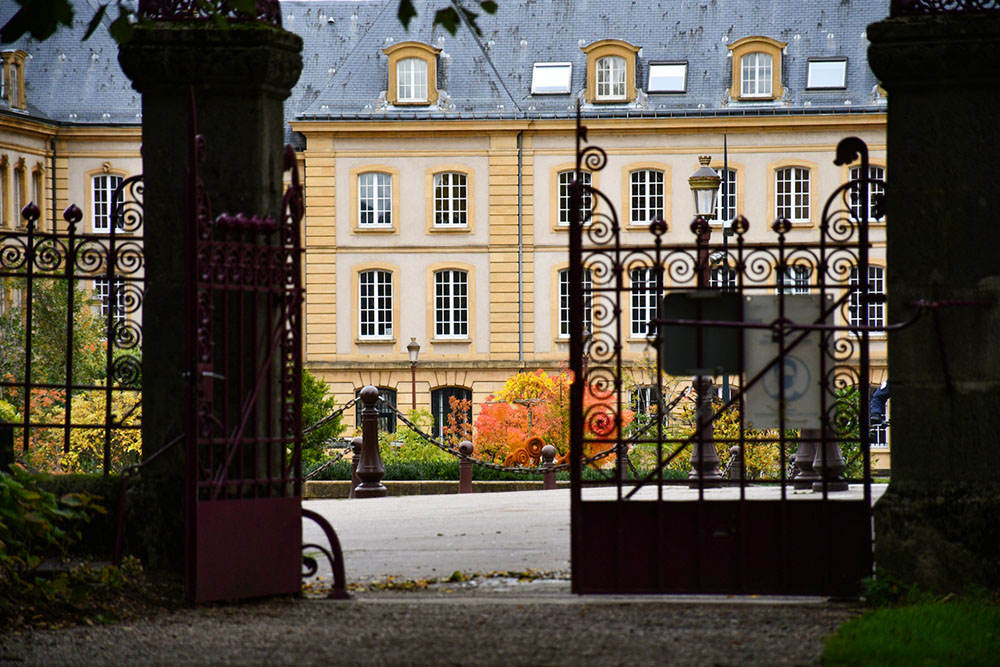
On the other, the Moselle wraps itself around the monument, offering the reflections that photographers love so much.
Around the church, the Jardin d’Amour adds a softer, almost romantic touch.
The name may raise a smile, but it suits the place beautifully. This is a garden for strolling, pausing, looking, and perhaps taking just one more photograph than you intended.
You see locals walking through, visitors stopping on the bridges, couples posing by the river, and people simply slowing down because the view asks them to.
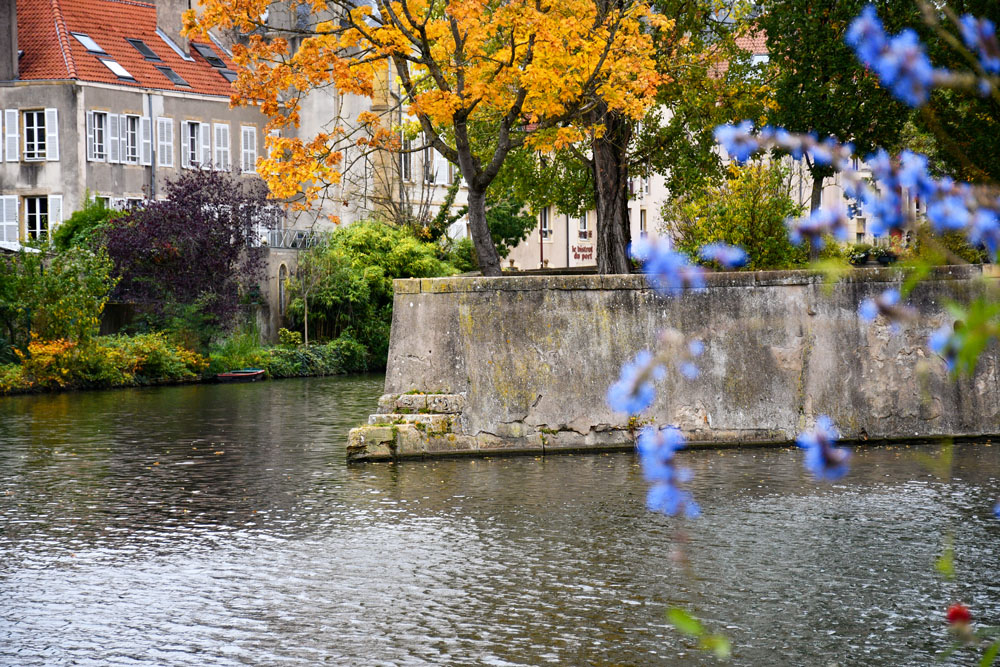
The Temple Neuf is not only a monument to visit.
It is a monument to walk around.
And that is part of its charm.
The best views of the Temple Neuf
To appreciate the Temple Neuf properly, you need a little distance.
And if you really want to understand the volume of the building, there is one viewpoint I particularly recommend: from the Moselle itself.
Seen from the water, the Temple Neuf changes. You no longer see just a façade or a postcard view from a bridge. You begin to understand its position on the Île du Petit-Saulcy, its relationship with the riverbanks, the trees, the Place de la Comédie and the reflections of the Moselle.
The building gains depth.
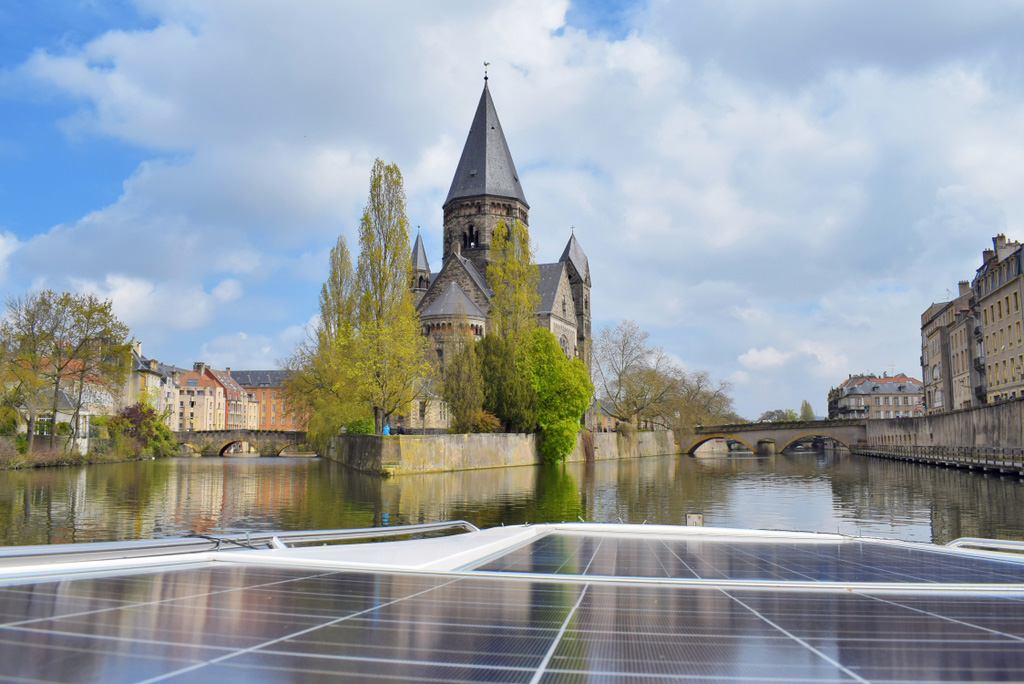
This is one reason why I highly recommend taking a solar boat cruise in Metz. The slow rhythm of the boat allows you to look at the city differently, without rushing from one viewpoint to another. The Temple Neuf is one of those landmarks that makes more sense when seen from the river.
I wrote more about this experience in my article about taking a solar boat cruise on the Moselle in Metz.
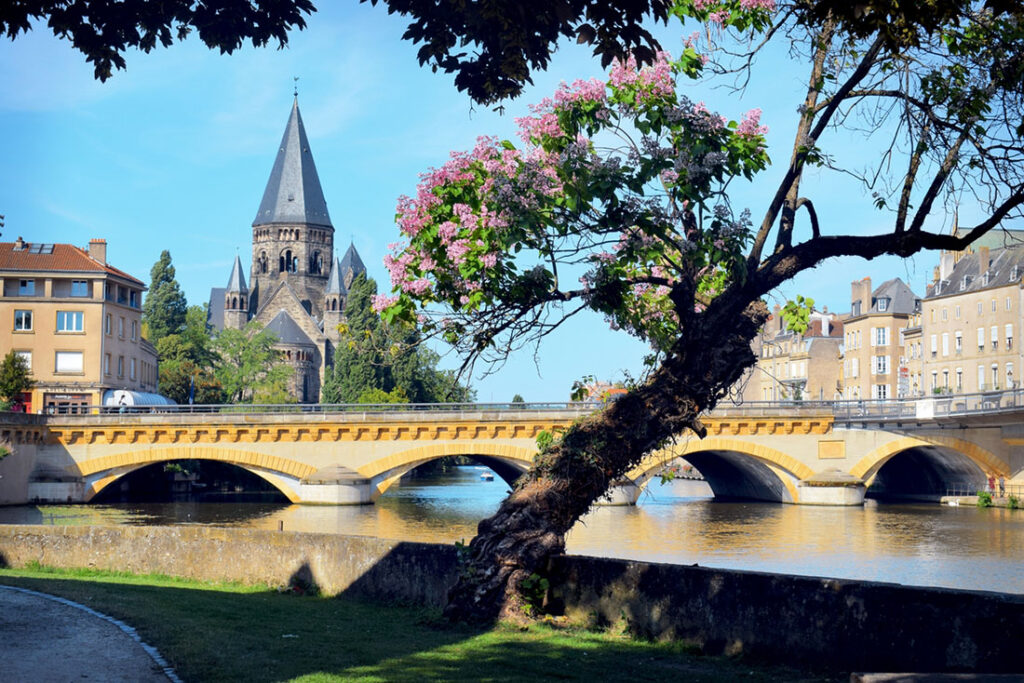
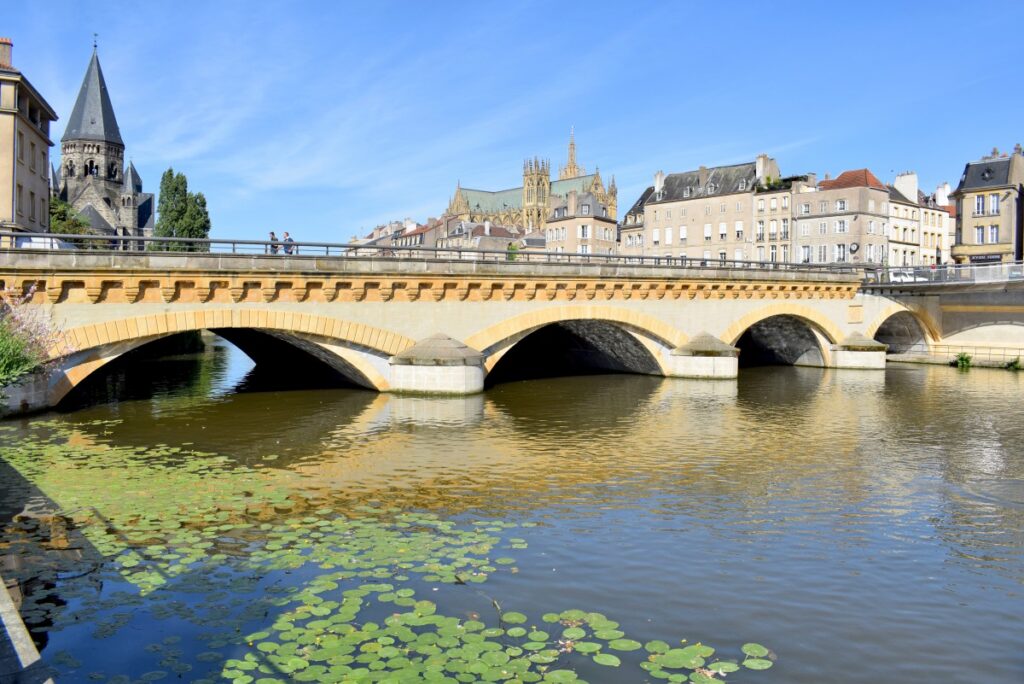
From the Moyen Pont, the church also offers one of the classic views of Metz.
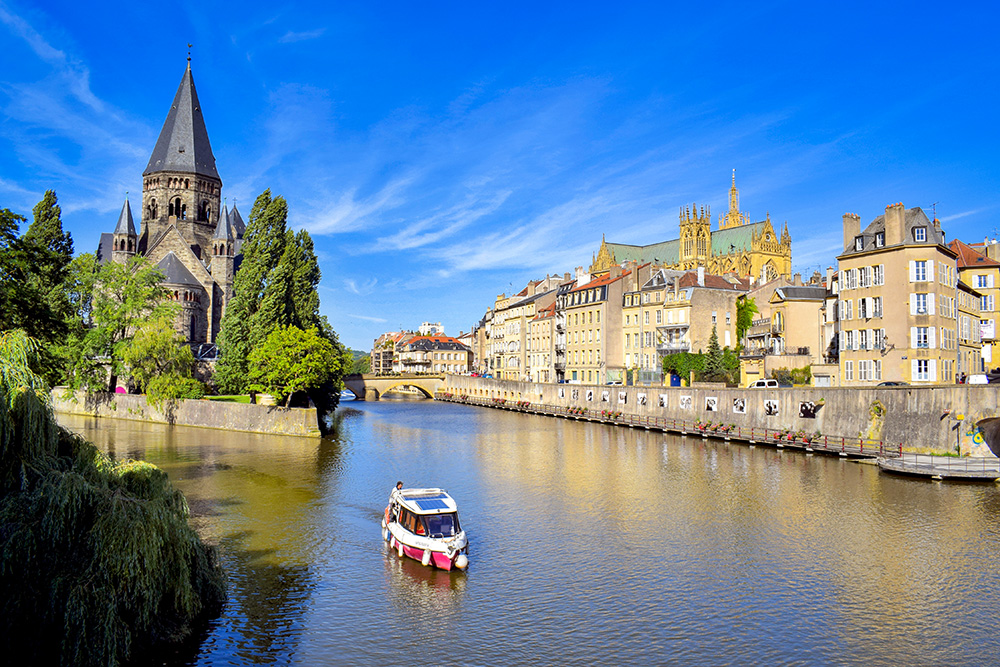
Its towers rise above the water, framed by trees and neighbouring buildings. It is easy to see why this angle has become one of the most photographed in the city.
From the Rue des Roches, the view feels more intimate. You sense the old town nearby, the density of the urban fabric, and the close relationship between Metz and its rivers.
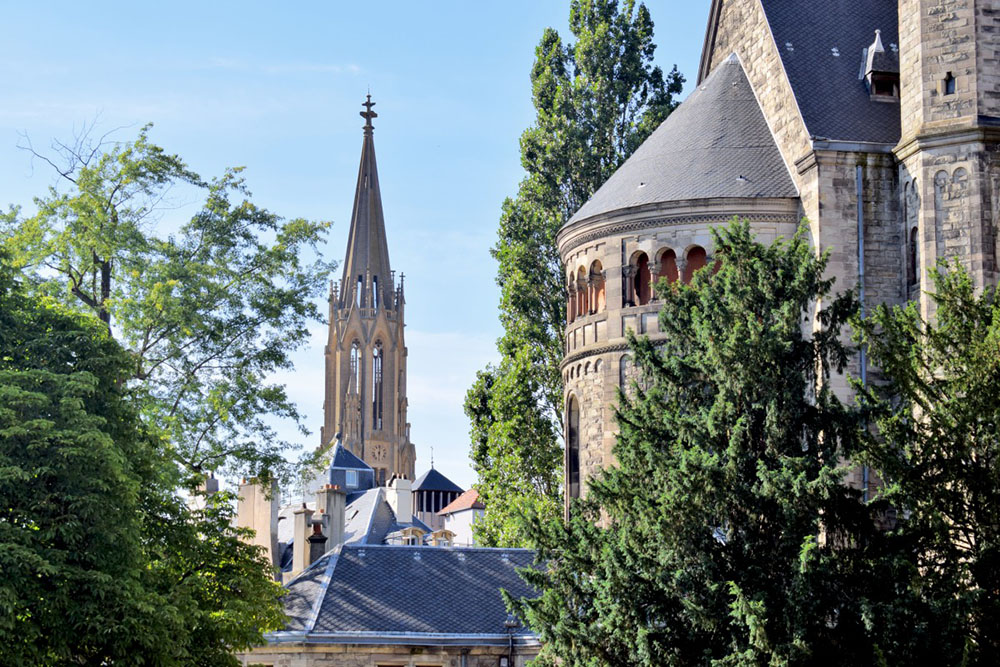
From the Place de la Comédie, the contrast is more striking. The Temple Neuf seems to answer the Opéra-Théâtre, but in a completely different language.

Classical balance on one side.
Dark Neo-Romanesque power on the other.
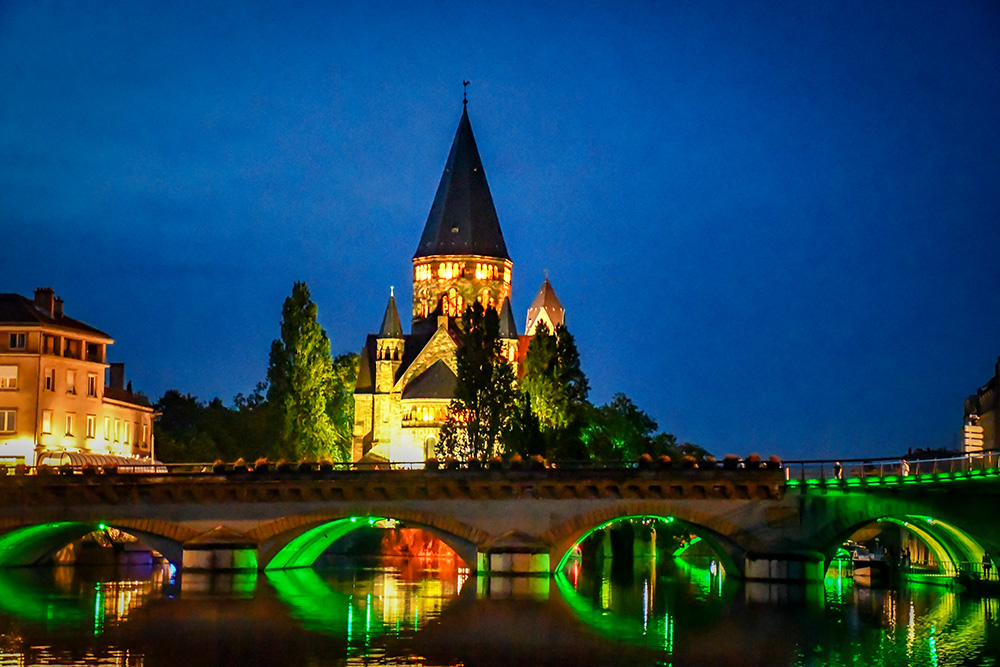
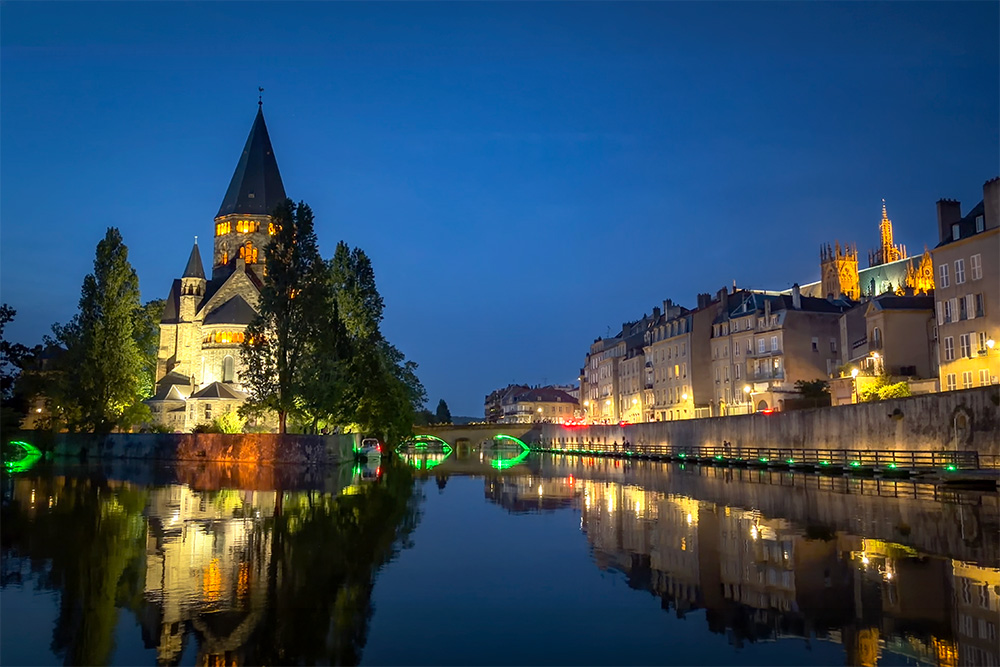
And then there is the night view.
When the Temple Neuf is illuminated, it takes on an almost theatrical presence. The dark stone, the towers and the compact mass of the building stand out against the evening sky.
It becomes another monument altogether: more mysterious, more dramatic, and perhaps even more beautiful.
The History of the Temple Neuf: A Church Born in German Metz
Metz during the German annexation
To understand the Temple Neuf, we need to return to Metz after 1871.
Following the Franco-Prussian War, Metz and part of Lorraine were annexed by the German Empire. The city became a strategic, military and symbolic place.
The German authorities did not merely administer Metz. They transformed it.
Architecture became a language of power.
New buildings were designed to show that Metz now belonged to the German Empire. The city had to be modernised, monumentalised, and visibly marked by its new political reality.
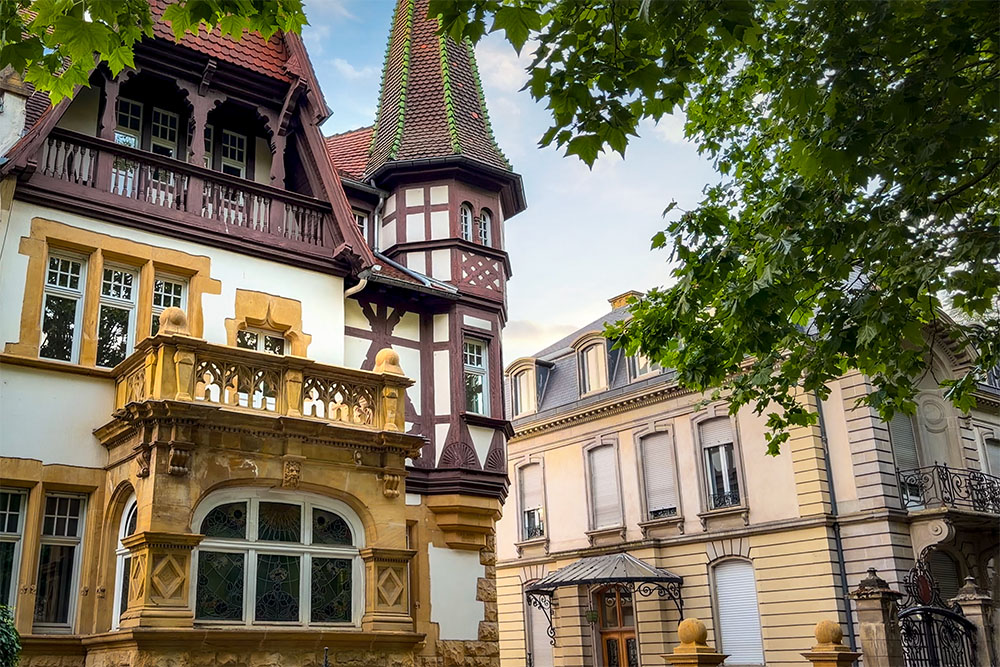
This was the period that gave Metz some of its most remarkable German-era buildings: the railway station, the Governor’s Palace, the central post office, and, of course, the Temple Neuf.
Today, these monuments form part of the city’s heritage.
But when they were built, they carried a strong message.
They were not simply practical or decorative.
They were statements.
Wilhelm II and the inauguration of the Temple Neuf
The Temple Neuf was designed by Konrad Wahn, the chief architect of the city of Metz.
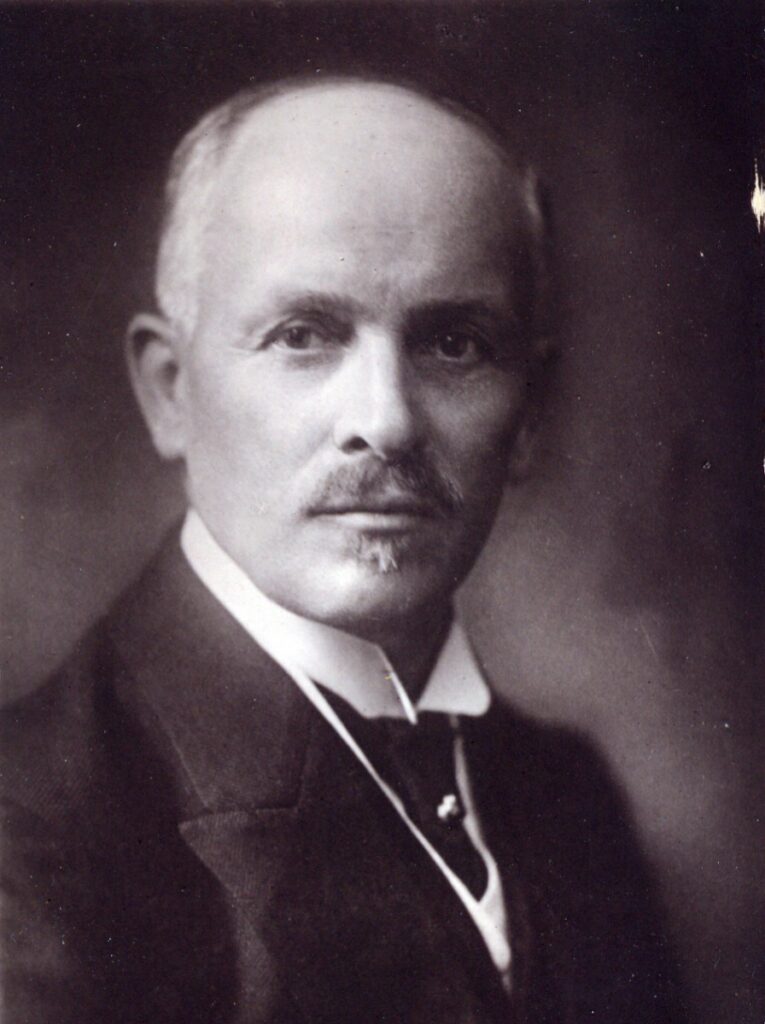
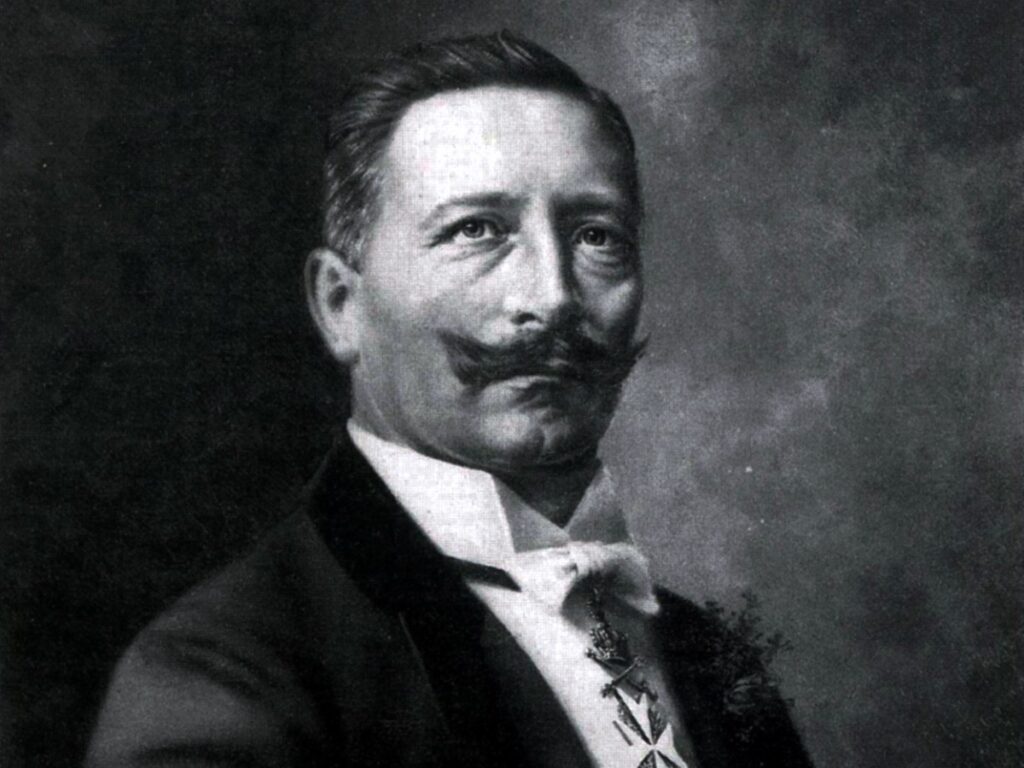
Construction began in the early 20th century, and the church was inaugurated on 14 May 1904 in the presence of Emperor Wilhelm II and Empress Augusta Victoria.
That detail alone tells us something about the importance of the building.
This was not a modest little church tucked away in a quiet corner. It was placed in one of the most prestigious sites in the city, facing the Place de la Comédie and visible from the river.
Even the name is interesting: Temple Neuf.
The “New Temple”.
Today, it looks old. Very old, in fact. But in 1904, it was indeed new. It was part of a transformed Metz, a city being reshaped under German rule.
That is one of the ironies of the monument.
It was built to express imperial modernity, but it did so using the architectural language of the medieval Rhineland.
A new church dressed as a very old one.
Why the Temple Neuf Looks So Different
Dark Vosges sandstone against golden Jaumont stone
In Metz, Jaumont stone is almost a signature.
It gives the city its warm golden colour, especially visible on the cathedral, the old town façades and many historic buildings. When sunlight falls on Metz, the stone can seem to glow.
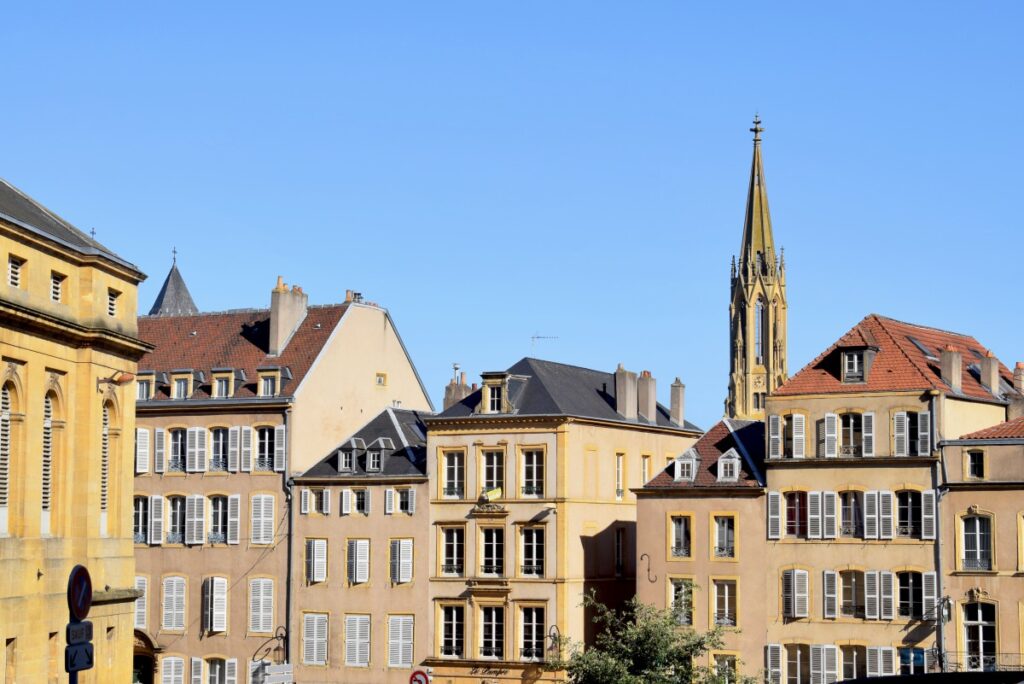
The Temple Neuf plays a completely different tune.
It is built in grey sandstone from the Vosges, a darker, cooler, more austere material. The contrast with the golden Jaumont stone is immediate.
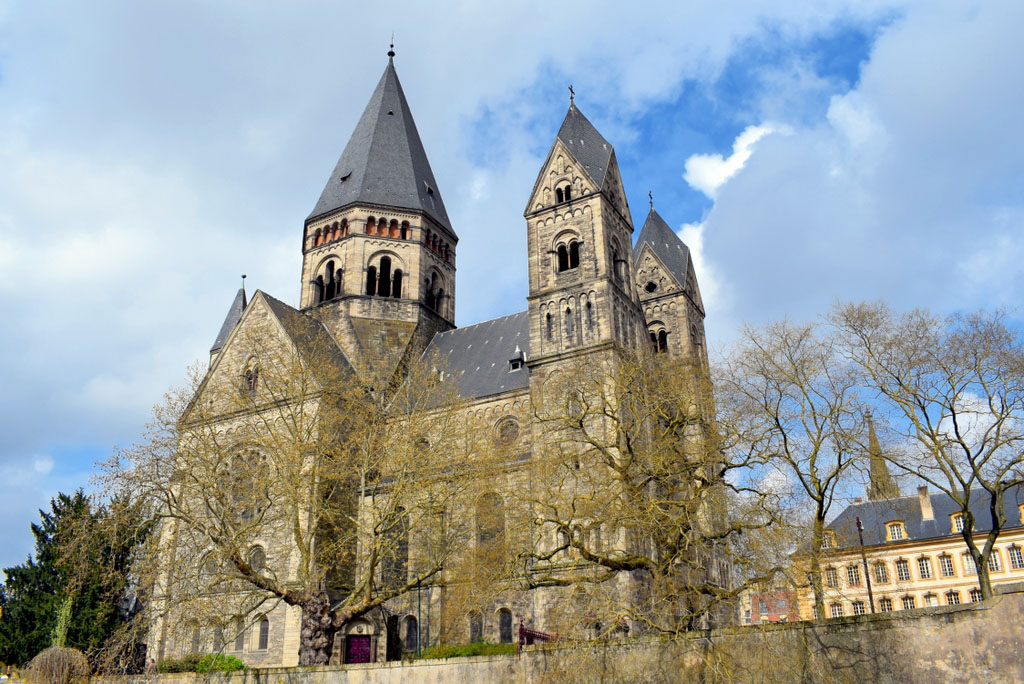
And this contrast is not accidental.
The Temple Neuf does not try to disappear into the cityscape. It does not politely blend in. It asserts itself.
It interrupts the visual harmony.
It catches the eye.
This impression also comes from its proportions.
The spire of the central tower at the crossing of the transept reaches 55 metres in height. It is not the tallest religious silhouette in Metz, of course.
The Tour de la Mutte at Saint Stephen’s Cathedral rises to around 93 metres, while the spire of the former garrison church reached 97 metres.
But the Temple Neuf does not need to be the tallest building to make an impression.
Its power comes from its position, its compact volume, its dark stone and its Neo-Romanesque mass standing by the water.
It does not dominate Metz in the same way as the cathedral.
It rises from the river landscape almost like a spiritual fortress.
And that is exactly why it intrigues.
A church that breaks the classical harmony of the Place de la Comédie
The Place de la Comédie is one of the most elegant urban spaces in Metz.
With the Opéra-Théâtre and its classical façades, the square speaks of balance, order and French 18th-century refinement.

Then, beside it, appears the Temple Neuf.
Massive. Romanesque. Dark. Rhenish.
It is easy to understand why the building was not universally loved when it first appeared. For some, it broke the harmony of the site. It seemed to challenge its surroundings.
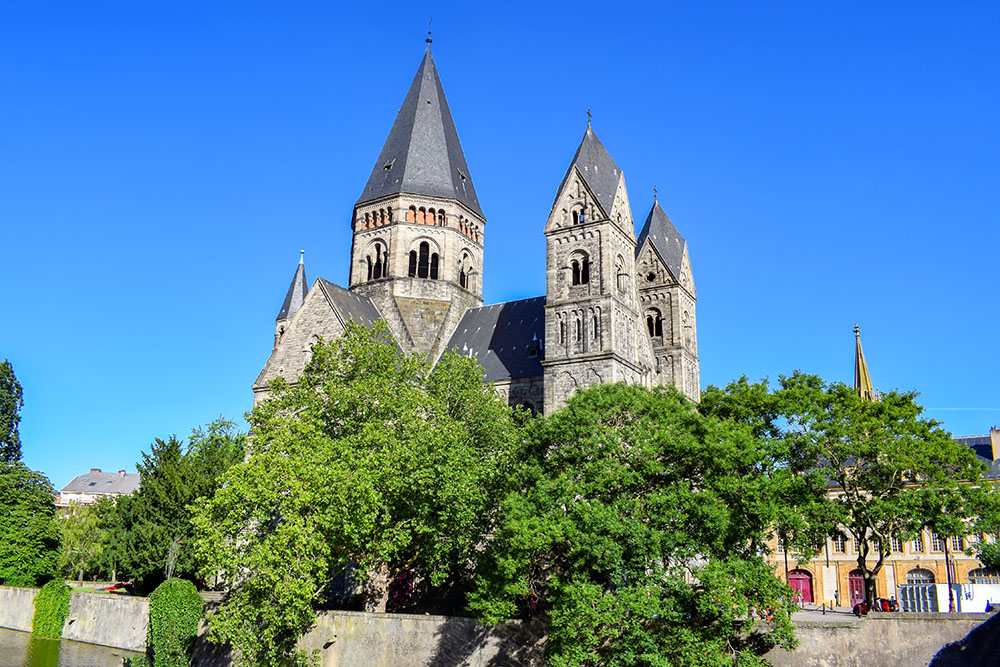
But that contrast is precisely what makes the place so fascinating today.
Metz is not a city of one single period. It is a city of layers, interruptions, borders and overlapping identities.
The Temple Neuf tells that story beautifully.
It is not there despite the history of Metz.
It is there because of it.
The Temple Neuf and Rhenish Neo-Romanesque Architecture
What the Temple Neuf owes to Speyer and Mainz
The style of the Temple Neuf is rooted in the Rhenish world. Its architecture clearly evokes the great Romanesque cathedrals of the Rhine valley, especially Speyer and Mainz.
And for me, this has a very personal resonance.
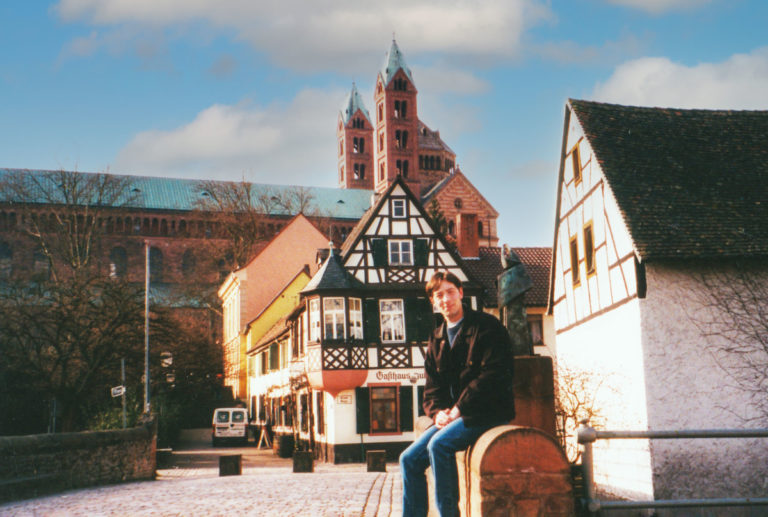
I spent my entire childhood in Speyer, in Germany. Speyer Cathedral was one of my great landmarks. I loved its massive silhouette, its imperial presence, its Romanesque forms, and the way it dominated the town without needing to be flamboyant.
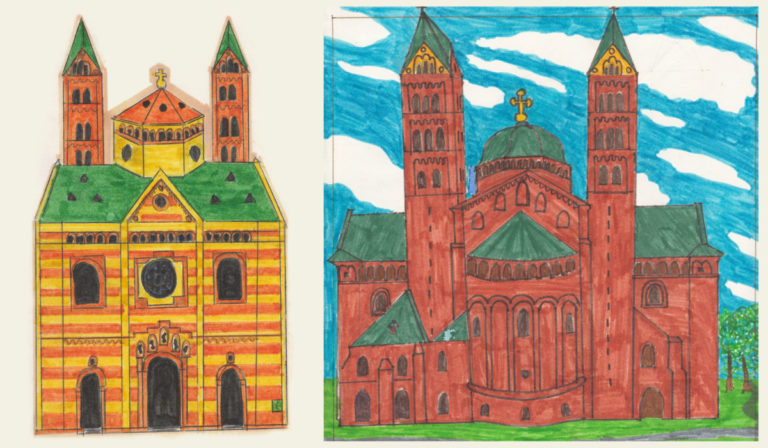
Only much later did I realise how much the Temple Neuf in Metz echoed that world.
The twin towers, the mass of the building, the galleries, the rounded arches, the compact strength of the structure — all these elements create an unmistakable connection.
There is, however, one important difference.
Speyer Cathedral is built in pink sandstone from the Palatinate, giving it a warm and almost gentle glow in certain lights. The Temple Neuf, by contrast, is built in grey Vosges sandstone.
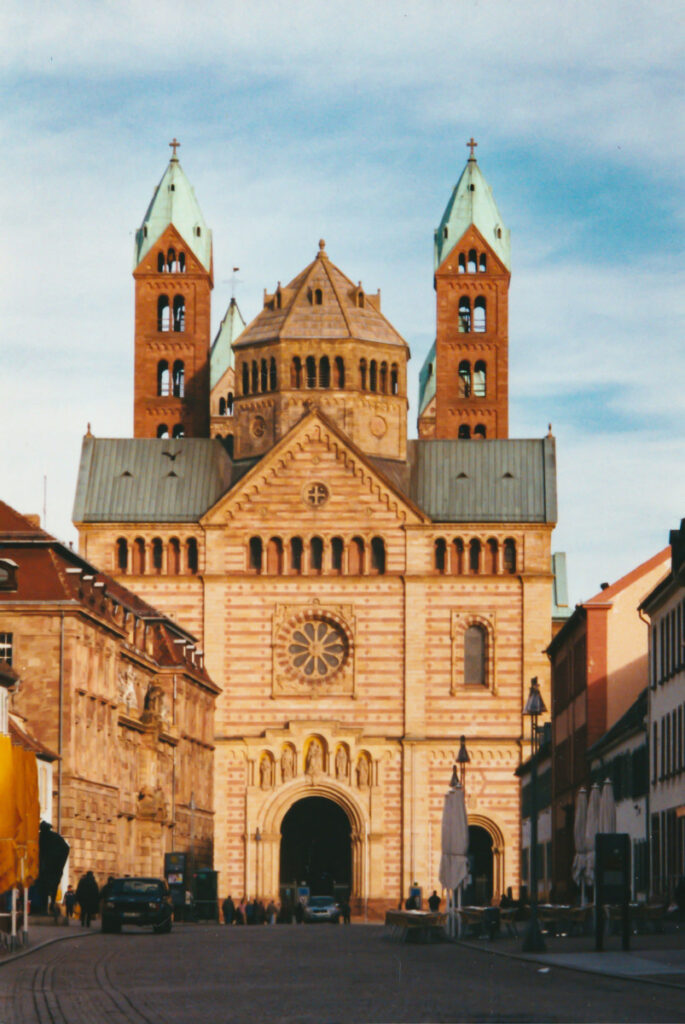
Similar inspiration.
Very different atmosphere.
In Speyer, the stone can feel almost soft.
In Metz, the Temple Neuf appears more severe, more foreign, more deliberately contrasted.
Perhaps that is why it intrigued me for so long before I understood why.
Details to look for on the Temple Neuf façade
The Temple Neuf deserves to be looked at slowly.
Not only from a distance, for its silhouette, but also up close, for its details.
The two western towers immediately draw the eye. They give the church a strong façade and reinforce its Romanesque character.
Look also at the Lombard bands, those small decorative arches running beneath the rooflines. They add rhythm to the walls and strengthen the impression of Rhenish Romanesque architecture.
The dwarf galleries are another important detail. Purely decorative, they recall the great Romanesque monuments of the Germanic and Rhenish world.
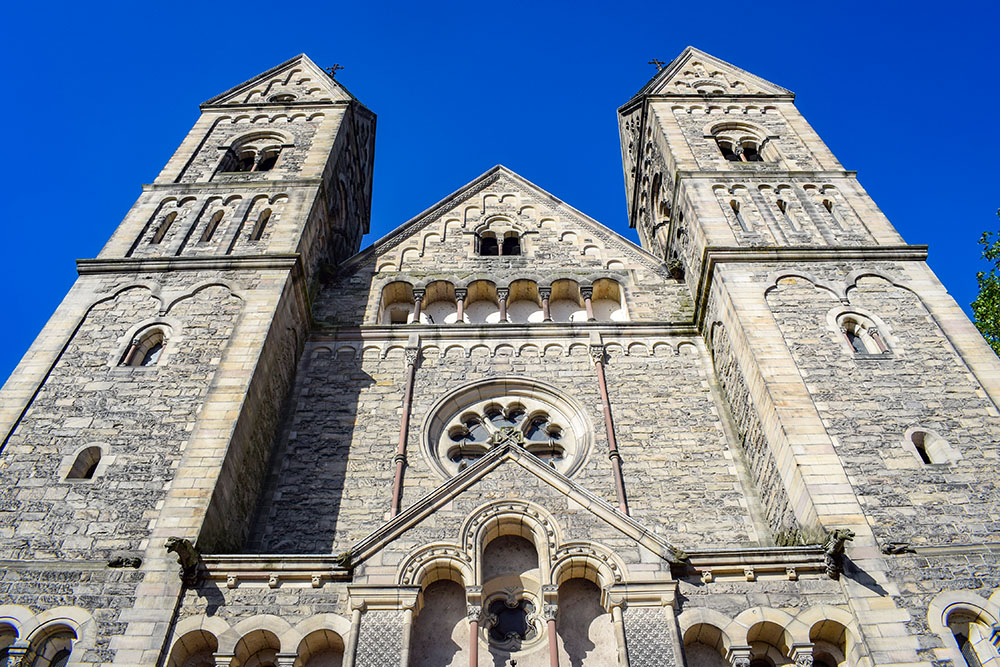
Around the portal, you can observe the symbols of the four evangelists and the Lamb of God. And if you take the time to look up, you may also notice animals, fantastical creatures and gargoyles in the form of birds or fish.
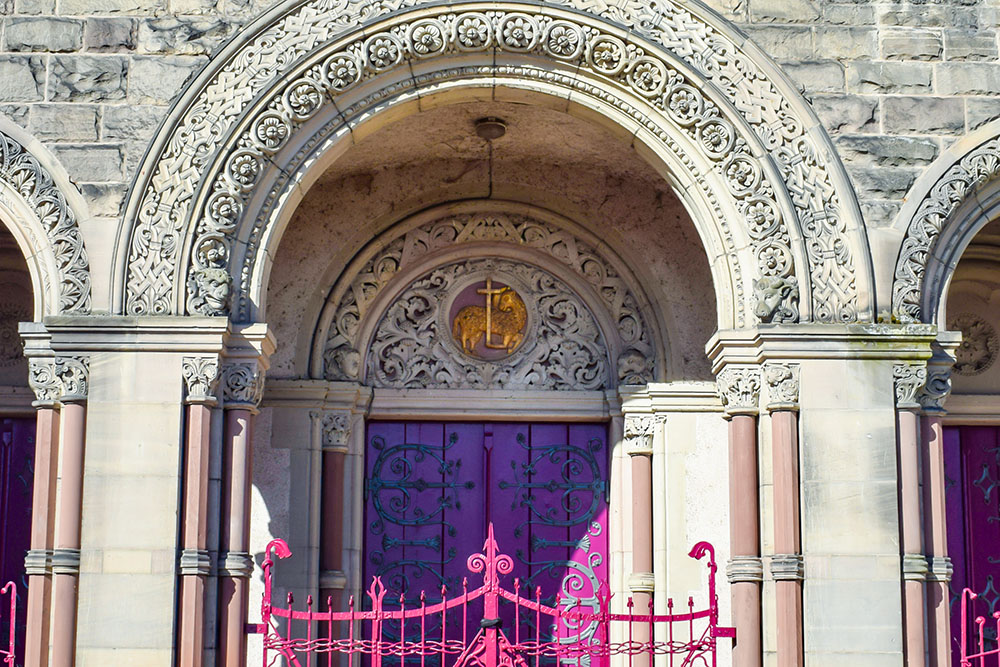
It is the kind of sculpted world you easily miss if you walk past too quickly.
And that would be a shame.
Inside the Temple Neuf: Protestant Sobriety and Atmosphere
A space designed for Reformed worship
From the outside, the Temple Neuf impresses through its mass and silhouette.
Inside, the atmosphere changes.
This is a Protestant space, designed for Reformed worship. The eye is not drawn towards an abundance of side chapels, gilding, statues or dramatic decoration, as it might be in some Catholic churches.
The spirit is different.
There is sobriety, clarity, and a focus on the Word, on listening, and on the gathered community.
The contrast with Saint Stephen’s Cathedral is striking.
The cathedral of Metz lifts your eyes towards light, height and stained glass.
The Temple Neuf invites you to understand a history.
The organ of the Temple Neuf
One of the great treasures of the Temple Neuf is its organ.
With its 52 stops across three manuals and pedalboard, it plays an important role in the musical life of the building. The church hosts recitals, concerts and cultural events, making it much more than a static monument.
This is one of the things I like about the Temple Neuf.
It is not just a building from the past.
It is still alive.
A place of worship, certainly, but also a place of music, listening and gathering.
And perhaps that is one of the reasons why a monument so closely tied to a complex historical period has managed to remain part of the city’s present.
The Jardin d’Amour Around the Temple Neuf
A romantic walk by the Moselle
The Jardin d’Amour suits its name rather well.
It surrounds the Temple Neuf and gives it a green setting beside the Moselle. This is a place where you naturally slow down.
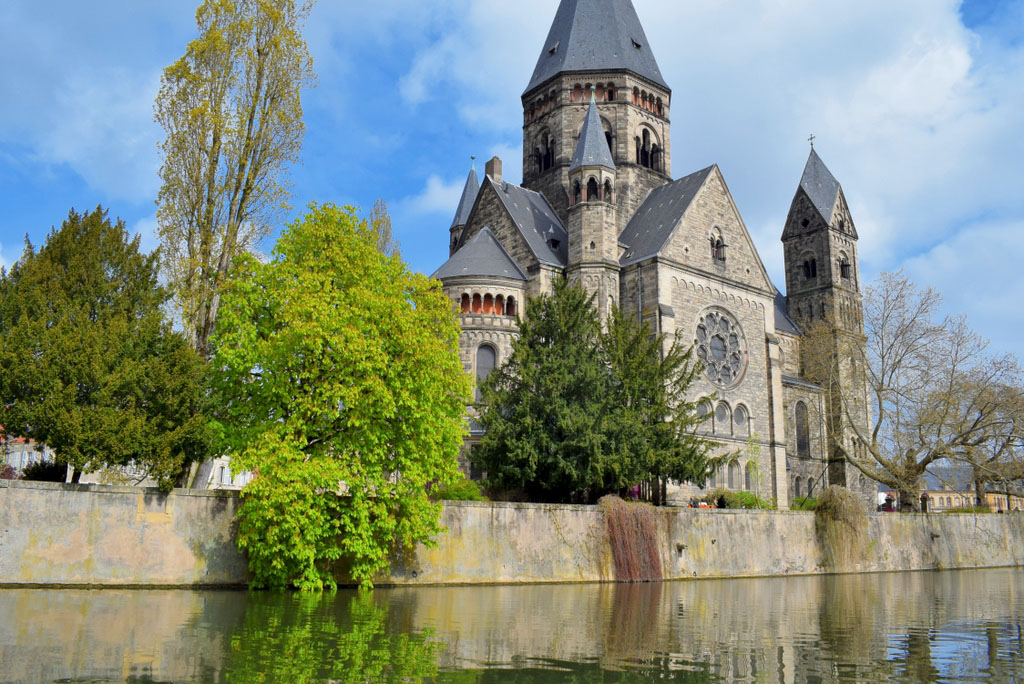
You might come here to photograph the church, wait for someone, cross the island, or simply enjoy a moment of calm in the middle of the city.
The Temple Neuf almost becomes a stage set.
Depending on the angle, it can look monumental, romantic, severe or melancholic. It changes with the light, the weather and the season.
Under a blue sky, it stands sharply against the water.
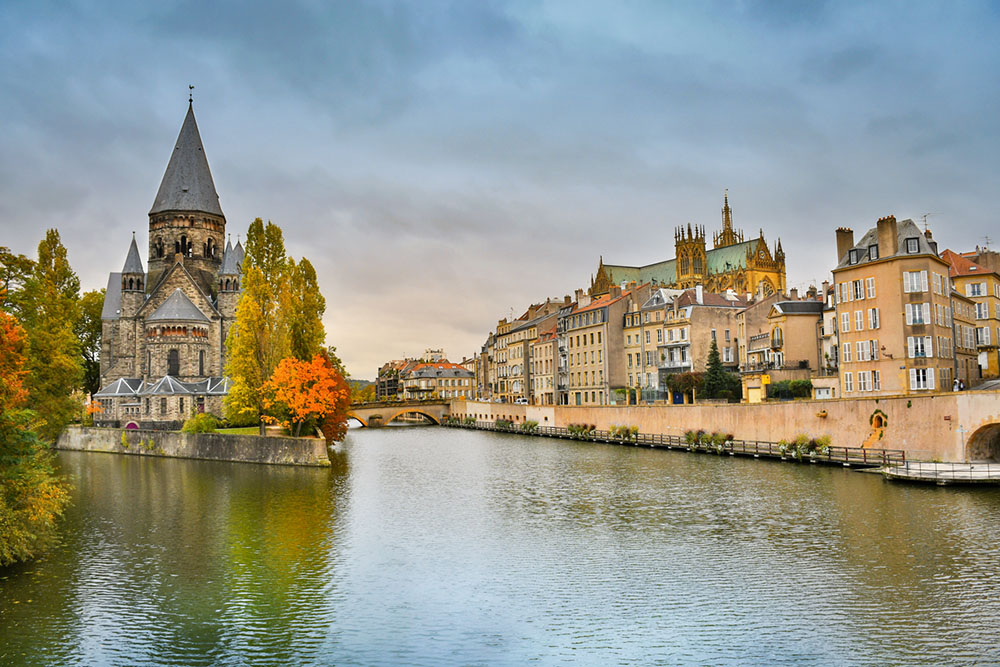
On a grey day, it becomes more dramatic.
In the evening, it can feel almost cinematic.
The Temple Neuf through the seasons and lights
If you visit Metz, do not settle for seeing the Temple Neuf only once.
Come back.
See it in the morning, when the city is still waking up. Return in the late afternoon, when the façades warm in the light and the Moselle catches the reflections. Come again after dark, when the illumination transforms the monument.
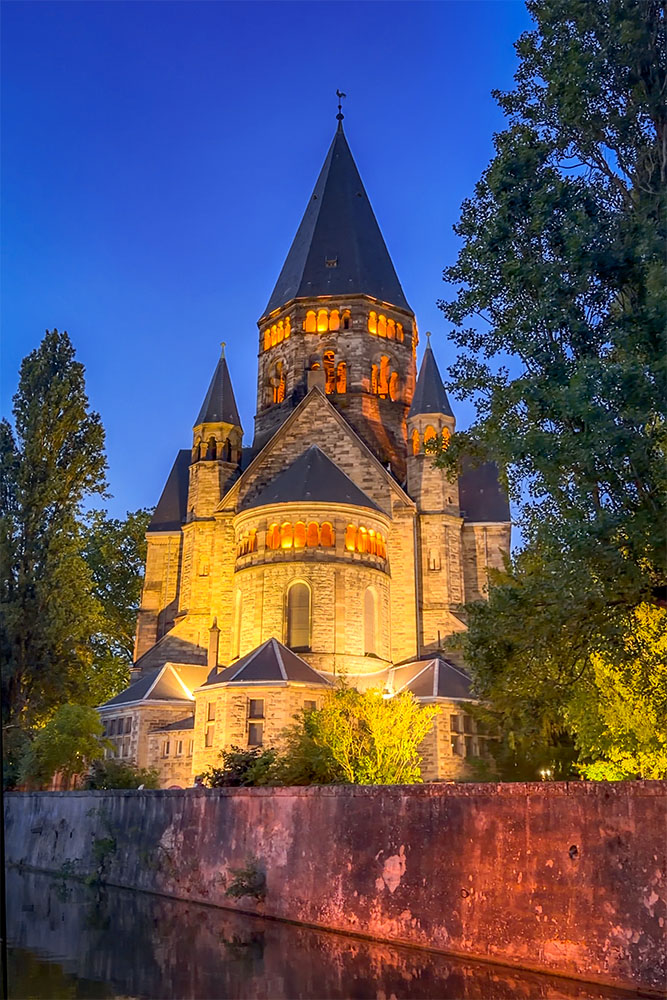
This is often the best way to understand a city.
Not by ticking monuments off a list, but by returning to the same place at different moments.
The Temple Neuf is one of those places that rewards a second look.
And then a third.
Temple Neuf Today: From Oddity to City Icon
A monument once criticised, now adopted
The Temple Neuf was not always loved.
Its style was criticised when it was built. For some Francophile residents of Metz, it represented an imposed architecture, a symbol of Germanisation, and a rupture with the classical harmony of the area.
After 1918, when Metz returned to France, the building remained associated with the German annexation.
One might imagine that such a symbol would have been rejected.
But the history of cities is rarely so simple.
Over time, the Temple Neuf was adopted.
It became one of the best-known silhouettes of Metz, one of those monuments people photograph, recognise and immediately associate with the city.
What once made it an oddity has become part of its charm.
How my own view of the Temple Neuf changed
Today, I no longer see the Temple Neuf as I did when I was a child.
I still find it impressive.
I still think it looks different.
But now I understand why.
It is not just a dark church by the Moselle. It is a witness to a complex period, a city pulled between France and Germany, and a region shaped by borders, languages and memories.
It also speaks to me personally because it creates an unexpected bridge between Metz and Speyer, between the Lorraine of my family and the Germany of my childhood.
Perhaps that is what touches me most.
The Temple Neuf is not merely a foreign-looking building in the Metz cityscape.
It has become truly Messin precisely because Metz itself is made of encounters, tensions, influences and layered histories.
It remains an anomaly.
But a legitimate one.
Visiting the Temple Neuf in Metz: Practical Tips
Access and visiting advice
The Temple Neuf stands at 1 Place de la Comédie, right in the centre of Metz.
It is easy to reach on foot from Saint Stephen’s Cathedral, the Place d’Armes, the Place de la Comédie and the banks of the Moselle.
If you are arriving by car, the underground car park at the Place de la Comédie is one of the most convenient options.
To visit the interior, it is best to check opening times in advance. The church may be open for certain afternoon visits, cultural events, concerts or parish activities.
And even if you cannot go inside, do not be too disappointed.
The Temple Neuf is already magnificent from the outside, especially if you take the time to walk all the way around it and observe it from several angles.
What to see near the Temple Neuf
The Temple Neuf stands in one of the most pleasant parts of Metz for a walk.
Just beside it, you can admire the Place de la Comédie and the Opéra-Théâtre, one of the oldest theatres still in operation in France.
In a few minutes, you can walk to Saint Stephen’s Cathedral, often nicknamed the “Lantern of God” because of its vast stained-glass windows.
You can also follow the Moselle, cross the Moyen Pont, explore the quays, and continue into the historic centre.
For me, the Temple Neuf works beautifully as part of a walking itinerary through central Metz.
It forms a natural transition between the classical city, the medieval city, the German imperial city and the river city.
In other words, everything that makes Metz so interesting.
Why the Temple Neuf Deserves More Than a Quick Photo
The Temple Neuf is not just a beautiful silhouette by the Moselle.
It is a monument that tells a story.
A story of stone, power, faith, memory and identity. A story that speaks of Metz, Lorraine, Germany, France, and that cultural frontier which has never been simply a line on a map.
For a long time, I saw it as a familiar backdrop.
Today, I see it as one of the key monuments for understanding Metz.
It intrigues because it contrasts.
It surprises because it looks ancient while being relatively recent.
It moves me because it was once controversial, yet has become part of the city’s soul.
So if you come to Metz, do not just take a quick photograph of the Temple Neuf from the bridge and move on.
Come closer.
Walk around it.
Look at the stone, the towers, the arches, the gargoyles and the reflections in the Moselle. Take your time.
At first glance, the Temple Neuf may seem like an architectural oddity.
But in Metz, the most interesting monuments are often the ones that ask for a second look.